Create moments, not just stays.
Unlock a curated collection of unique hospitality concepts from rooftop cinemas to handwritten notes. Discover how to craft memories that earn 5-star reviews.
Airbnb description
generator tool
Write the full listing, Summary, The Space, Guest Access, Neighborhood, and Notes. Five sections, structured the way Airbnb actually displays them. Free, no signup required.
How does the tool work?
Most Airbnb description generators give you one blob of text and call it done. That's not how Airbnb displays your listing, and it's not how guests read it.
The real Airbnb description has five distinct sections, each doing a different job. The Summary is the hook guests see before "Show more." The Space explains what the property is. Guest Access clarifies what they can use. The Neighborhood sells the local area. Other Notes flags anything worth knowing upfront.
This tool writes all five in the right structure, with the right length for each. No email, no signup. If you haven't written your listing headline yet, start with the Airbnb title generator first, that's the 50-character line guests see in search results, which is a different tool for a different job.
The five sections of an Airbnb description (and why they matter)
Airbnb used to show listings as one long wall of text. In the current layout, that wall is broken into sections, and each one appears at a different moment in the guest's decision.
The Summary is what shows up first. It's the paragraph before the "Show more" link. On mobile, most guests will only read this section before deciding whether to keep scrolling. Its only job is to earn the second glance. If your summary is generic ("Welcome to our beautiful home"), the guest is already gone.
The Space is where you actually describe the property. Layout, feel, the things that photos don't quite capture. This is your opportunity to paint a picture, but not an inventory. Nobody needs a bullet list of every appliance.
Guest Access answers a specific question: what can I actually use? Do I have the whole place, or just a room? Can I use the garden, the hot tub, and the parking space? This section exists to prevent confusion before it becomes a one-star review.
The Neighborhood is where most hosts get lazy. "Close to restaurants and shops" describes every neighborhood. Guests want the real local flavour, the coffee spot three doors down, the farmers' market on Sundays, and the walkability to the train station. Specificity wins.
Other Notes is the honesty section. Quirks, rules, anything worth flagging upfront. A polite heads-up about the creaky stair or the 10 pm quiet hours builds trust. Hiding these things guarantees you'll hear about them in the review.
How to write a Summary that earns the click
You have roughly 450-500 characters before "Show more" cuts you off. Treat it like a movie trailer, not a synopsis.
Lead with the single most interesting thing about your property. If it's oceanfront, say oceanfront in the first five words. If it's a converted barn, say converted barn. Whatever's in your photos that made the guest click, that's what belongs in the summary.
Skip the phrases every other listing uses. "Welcome to," "perfect getaway," "relax and unwind," "home away from home." These are invisible, guests skim right past them because every listing uses them. The space they take up could be a real detail that makes your property specific.
Short sentences work better than long ones. Guests are scrolling on phones; they're skimming. Three tight sentences beat one flowing paragraph almost every time.
End with a hint of what the rest of the description will cover, so clicking "Show more" feels worthwhile. Something like "Read on for the local spots we actually use" pulls people in without being pushy.
How to write the Space section
This is where you get to stretch, but not sprawl. The Space should feel like you're describing the property to a friend who asked what it's like, not reading from a property management template.
Cover the layout in a way that helps guests picture it. Which floor, how many rooms flow into each other, and where the outdoor space is. If the kitchen is the heart of the property, say so. If guests spend most of their time on the terrace, describe the terrace.
Mention the standout features once, with specificity. "A wood-burning fireplace with a stack of seasoned oak" beats "cozy fireplace." "A claw-foot bath under a skylight" beats "bathtub." Specifics make a description feel like a real place rather than a stock image.
Don't list every amenity here. Guests see the amenities list separately on Airbnb, repeating it in the description wastes words and makes you sound like a brochure. Stick to what amenities you have that feel different, or the way a common amenity is better than average (a properly equipped kitchen beats "kitchen", and "a 65-inch TV with Netflix already signed in" beats "TV").
How to write Guest Access
This one's practical, not poetic. Make it clear what the guest has access to, and just as importantly, what they don't.
If it's an entire place, say so: "You'll have the whole property to yourselves." If you live on-site, say that too: "We live in the adjoining cottage, but you'll have complete privacy in the main house." If there are shared spaces, clarify: "The garden is shared with the upstairs unit, but you're welcome to use it anytime."
Anything with ambiguous access needs a clear answer. Can they use the hot tub? The bicycles in the shed? The outdoor kitchen? Spell it out. Guests who have to ask feel like they're imposing; guests who already know what's theirs feel at home.
Keep this section short. 150-300 characters is plenty. It's informational, not sales copy.
How to write The Neighborhood
The neighborhood section is where you either win or lose repeat bookings. It's also where most hosts phone it in.
Be specific about where the property actually is. "15-minute walk to the old town" beats "close to everything." "Two minutes to the nearest tram stop" beats "great transport links." Use real times and real distances.
Mention places by name. The cafe on the corner. The bakery two streets over. The pub everyone locals go to. Guests Google these names, having real places in your description boosts your listing's relevance in search and gives guests something to plan around.
Describe the vibe of the street, not just its amenities. Quiet residential? Busy with cafes? Lined with old trees? Guests are choosing an experience, not just a roof. The feel of the area matters as much as what's nearby.
If the area has any downsides, traffic noise, limited parking, quiet on Sundays — address them honestly. Honesty about small drawbacks makes the positives more believable.
How to write Other Things to Note
Treat this like the conversation you'd have with a guest on check-in if you could meet them in person.
Flag anything that could surprise them. Stairs to reach the property. A shared entrance. A dog that lives next door. Quiet hours after 10pm. These aren't weaknesses, they're expectations you're setting, and guests reward hosts who set them well.
House rules go here too, but in a friendly tone rather than a list of "no." "We ask guests to treat the space like their own" lands better than "NO PARTIES. NO SMOKING. NO SHOES."
Finish with a warm line. Something like "Any questions during your stay, we're just a message away." It signals responsiveness, which is one of the things Airbnb's algorithm measures.
Common mistakes that flatten your listing
Front-loading with "welcome." The word "welcome" in the first sentence is a signal to the guest's brain to stop reading. It's noise. Start with something concrete.
Describing amenities Airbnb already shows. Wifi, parking, and AC are on the amenities panel. Putting them in the description wastes space.
Overusing adjectives with nothing behind them. "Beautiful," "stunning," "amazing," "perfect" mean nothing because every listing uses them. Show, don't tell, one specific detail beats five empty superlatives.
Writing for Google keywords instead of guests. Stuffing "Airbnb vacation rental near downtown with pool and wifi" into your description doesn't help your Airbnb ranking. It does make your listing feel robotic. Airbnb's algorithm is about engagement and bookings, not keyword density.
Forgetting that guests skim. Short paragraphs. Short sentences. Specific details. Skimmers catch the details; slow readers get the full picture. Both get what they need.
Ignoring the neighborhood section. This is your biggest differentiation opportunity and most hosts waste it on "plenty of restaurants and shops." Write the neighborhood like you actually live there, because you either do or you've visited enough to write like you do.
How long should each section be?
Airbnb doesn't publish strict limits on most sections, but these are the lengths that perform well in practice:
- Summary: 350-500 characters. Hard cap at 500 before it truncates.
- The Space: 400-700 characters. Enough to paint a picture, not so much that guests skim.
- Guest Access: 150-300 characters. Factual.
- The Neighborhood: 300-500 characters. Specific enough to feel real.
- Other Notes: 150-300 characters. Brief is better than thorough here.
Total: roughly 1,400-2,300 characters across all five sections. Shorter listings often outperform longer ones because guests finish reading them.
Elevate every stay into a 5-star experience
Our digital guidebooks enhance guest satisfaction by providing:
- Essential Info: All necessary details, from WiFi to house rules, in one accessible place.
- Local Favorites: Insider tips on the best local spots to ensure an unforgettable visit.
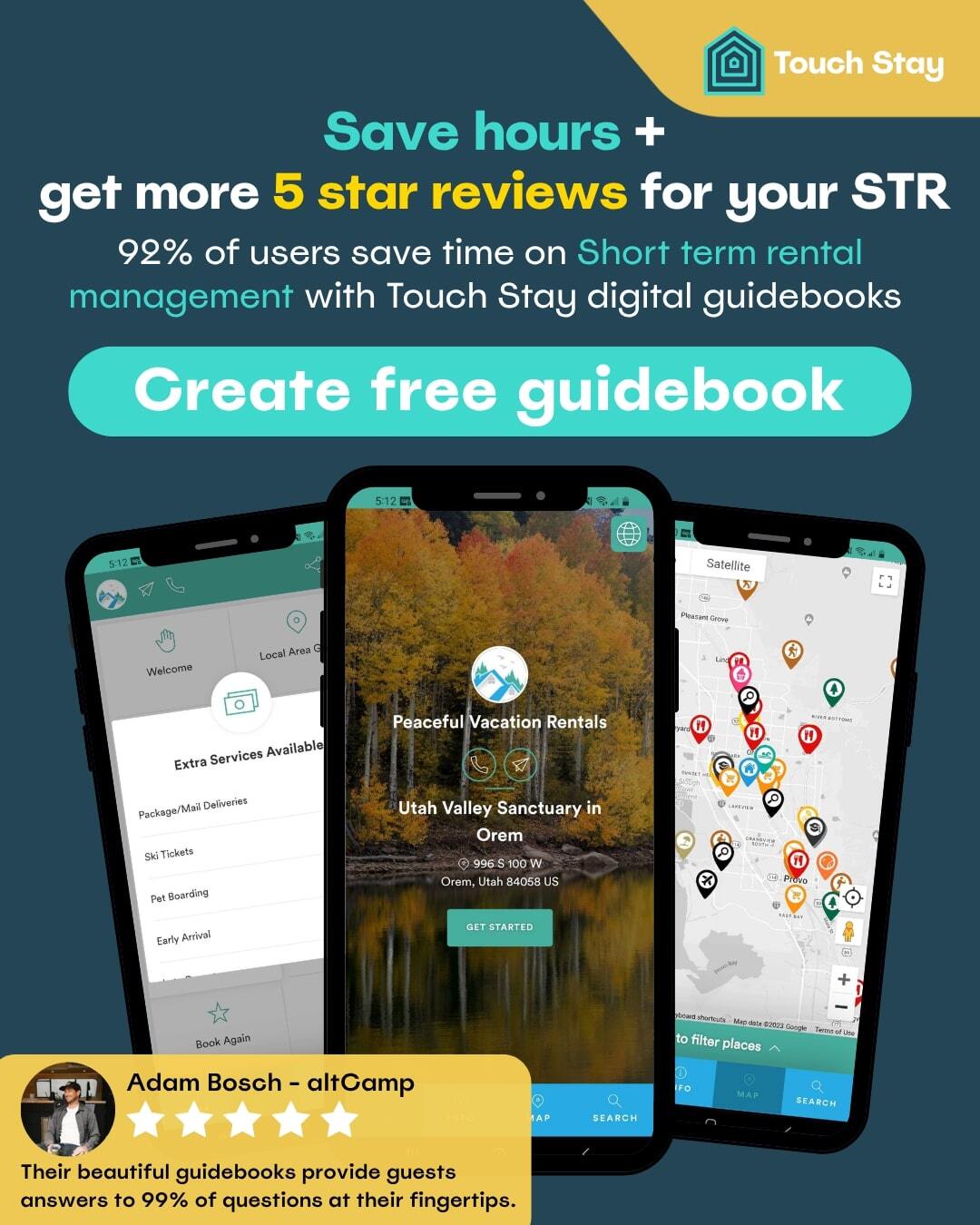
- Seamless Communication: Reduce questions with easy-to-find answers, streamlining guest interactions. 92% of users report saving time by using our guidebooks.
Touch Stay guidebooks lead to improved guest experiences and more 5-star reviews.

Want to learn more about Touch Stay?
We’d love to show you around!
Why not sign up for our 14-day free trial?
(No credit card needed!)