

Summarize in
Most articles on Airbnb check-in instructions hand you a generic template, walk you through the platform's setup screen, and call it a day. That's fine if you've never written one before. It's not fine if you're trying to figure out why guests still message you at 11pm asking where the lockbox is.
We have data on that. A lot of it.
This year we analysed 37,359 guest conversations across 11,293 Touch Stay properties via our AI chatbot, surveyed 1,204 short-term rental guests, and surveyed 1,365 STR hosts and property managers for the 2026 Host Report. The picture that emerged is uncomfortable: check-in is simultaneously the moment guests care about most, the moment hosts are most likely to under-deliver, and the single biggest source of in-stay friction across the entire industry. If you fix nothing else about your guest experience this year, fix this.
- The number every host should know: 88.7%
- What actually goes wrong: data from 37,359 chatbot conversations
- What guests notice when check-in goes right (and wrong)
- What to actually put in your Airbnb check-in instructions
- The delivery problem: how guests actually want to receive this
- Where most hosts are missing a clear revenue lever
- A check-in instructions message template that actually works
- The check-in instructions checklist
- The bigger picture
The number every host should know: 88.7%
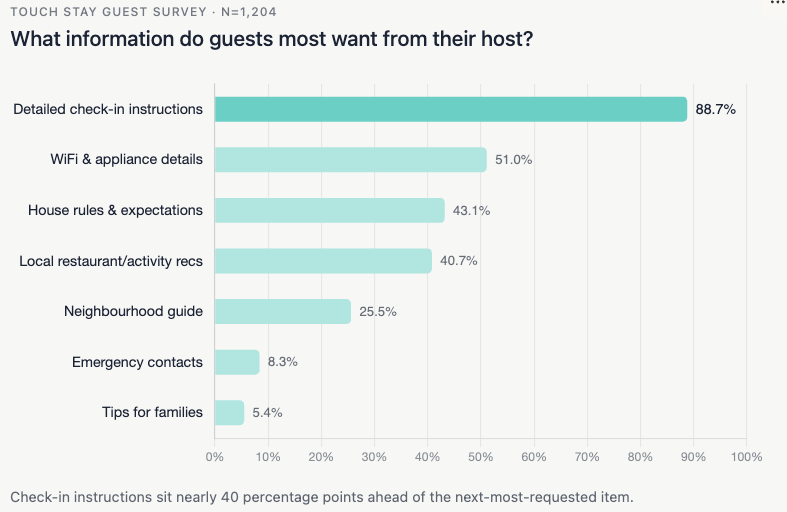
We asked guests what information they most want to receive from their host before arrival. Out of seven options, one answer dominated:
|
What guests want from their host |
% who selected it |
|
Detailed check-in instructions (codes, parking, etc.) |
88.7% |
|
WiFi, appliance instructions, property details |
51.0% |
|
House rules and what to expect |
43.1% |
|
Local restaurant/activity recommendations |
40.7% |
|
Neighbourhood guide (grocery, pharmacy, etc.) |
25.5% |
|
Emergency/important contacts |
8.3% |
|
Tips for families/specific needs |
5.4% |
Nothing else comes close. Detailed check-in instructions sit nearly 40 percentage points ahead of the next most-requested item. It is the one piece of information almost every guest, regardless of trip type, length, or platform, expects to receive.
Yet when we cross-referenced this with how hosts actually share property information, a real gap appeared. Among the 1,365 hosts we surveyed:
- 44.9% still rely on a printed guidebook left at the property
- 41.9% give in-person briefings
- Only 35.3% use a digital guidebook or app
- 20.5% have no formal information-sharing process at all
A printed guidebook is useless for check-in. Guests need check-in details before they arrive, on their phone, while they're navigating a strange neighbourhood with a suitcase. The most common delivery method in the industry is structurally mismatched to the single most important moment in the guest journey.
What actually goes wrong: data from 37,359 chatbot conversations
Knowing guests want detailed check-in instructions is one thing. Knowing what they actually ask once instructions exist is another.
Touch Stay's AI chatbot handled 37,359 conversations across 11,293 properties between November 2025 and May 2026. Check-in was the second most-asked topic overall, generating 3,822 questions — second only to WiFi.
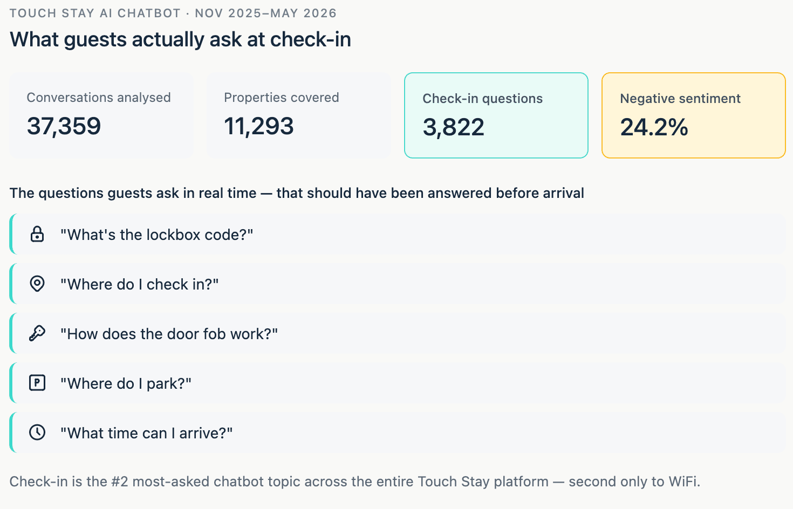
But the more revealing finding was which check-in questions got asked. The dominant sub-topics were:
- "What's the lockbox code?"
- "Where do I check in?"
- "How does the door fob work?"
- "Where do I park?"
- "What time can I arrive?"
These are not edge cases. They are the basics. Every one of these questions should have been answered before the guest arrived — in the check-in instructions. The fact that thousands of guests are asking them in real time means the instructions either didn't exist, weren't read, or didn't contain the right information.
And here's where it gets expensive: 24.2% of all chatbot conversations carried negative sentiment, and 15.2% returned "no information found" when a guest asked a question. Check-in friction was one of the top clusters driving both numbers. When a guest is standing outside your property unable to get in, the cost isn't just frustration — it's the review, it's the rebooking, it's the next guest who reads that review.
What guests notice when check-in goes right (and wrong)
When we asked guests what makes a stay worth a 5-star review, two answers stood out:
- 53.9%: "Accurate listing / no surprises"
- 51.0%: "Everything matched the listing exactly"
- 49.0%: Excellent communication and information provided
Look at those answers. They are all about expectations being met. Check-in is the first test of that promise. If the lockbox code in your message doesn't work, or the address sends them to the wrong building, the listing — in the guest's mind — has already failed before they've set foot inside.
The same logic appears on the negative side. Among the most common triggers for negative chatbot sessions, the top clusters were check-in failures (wrong codes, missing instructions, can't locate the property), in-stay technical issues (WiFi down, no hot water), and lockouts. The first and last are check-in problems.
What to actually put in your Airbnb check-in instructions
Generic templates list the obvious: address, code, WiFi. Our data tells us what to add to that list — the questions guests actually ask when "the obvious" turns out not to be obvious at all.
Send all of this, in this order:
1. "Check-in is from 4pm" is not enough. Add: what to do if they arrive at 2pm (where can they leave bags?), what happens if they arrive after 11pm (is the lockbox lit? does the code still work?), and whether early check-in is available and how to request it. A separate Airbnb arrival guide sent the day before is one of the highest-leverage habits a host can build.
2. Pin-drop directions to the actual entrance
Not the building address. The specific door. Apartment blocks, gated communities, and properties on long driveways are where this fails hardest. Use a Google Maps or What3Words link to the exact entry point.
3. Parking instructions, with a backup
Where do they park? Is there a permit? What if the spot is taken? What's the nearest paid alternative? The "what if the spot is taken" question is one guests rarely think to ask until they're circling the block at 9pm.
4. The exact access method, step by step
"There's a lockbox" is not instructions. "The lockbox is on the brick wall to the right of the green door. Code is 4729. Turn the dial all the way right until it stops, then pull down" is instructions. Add a photo. Lockboxes look different in the dark. (For more on smart locks and contactless entry, see our self check-in guide.)
5. What to do immediately after entering
Where's the light switch? Is there an alarm to disarm? Where do they put their shoes? This is the moment a stranger walks into your home for the first time. The 30 seconds after they're inside should be choreographed.
6. WiFi credentials — visible immediately
WiFi is the #1 chatbot question across our entire dataset. Don't bury it in a welcome book. Put it in the check-in message and on a card by the door.
7. The first thing you want them not to do
Don't flush wipes. Don't slam the patio door. Don't park in the spot marked "Reserved." Whatever the property-specific landmine is, mention it now — not in a frustrated message at 1am. (Full house rules belong in your guidebook; the check-in message just flags the single most consequential one.)
8. A direct contact and a clear escalation path
Who do they message for what? When can they expect a reply? If it's a real emergency, what's the number?
The delivery problem: how guests actually want to receive this
Here's the trap. You can write the perfect check-in instructions and still fail at delivery — because delivery is really two questions: how do guests want to be notified, and where do they want the information itself to live?
Most hosts answer only the first question and lose the second.
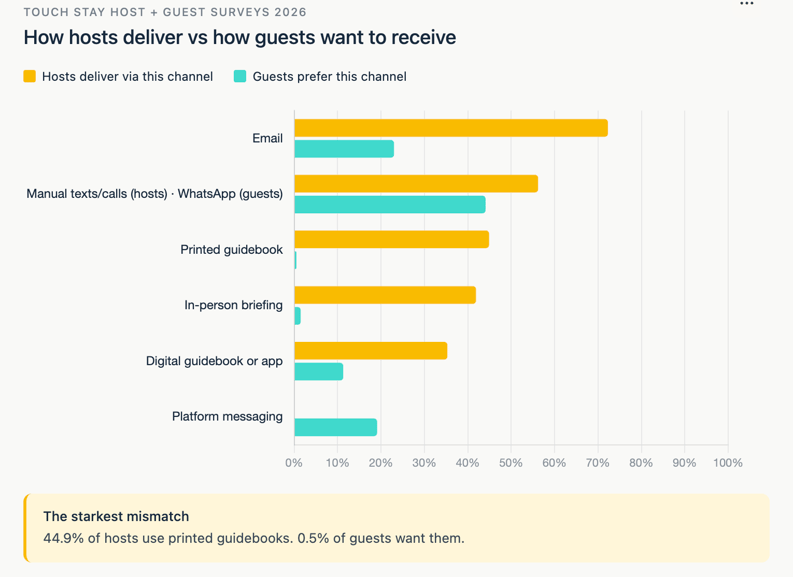
When we asked guests which single channel they most prefer for receiving information from their host, the answers split like this:
- 44.1%: Text / WhatsApp messages
- 23.0%: Email
- 19.1%: Platform messaging (Airbnb, Vrbo)
- 11.3%: Self-service digital guidebook
- 1.5%: In-person conversation
- 0.5%: Printed materials at property
At first glance, that 11.3% looks small. But the question forced guests to pick one channel, and what they picked was the alert — the ping that tells them check-in info has arrived. Of course that's WhatsApp; nobody opens Airbnb's app to read a check-in message at 4pm.
The question of where the information itself should live tells a very different story. Two other survey results made this clear:
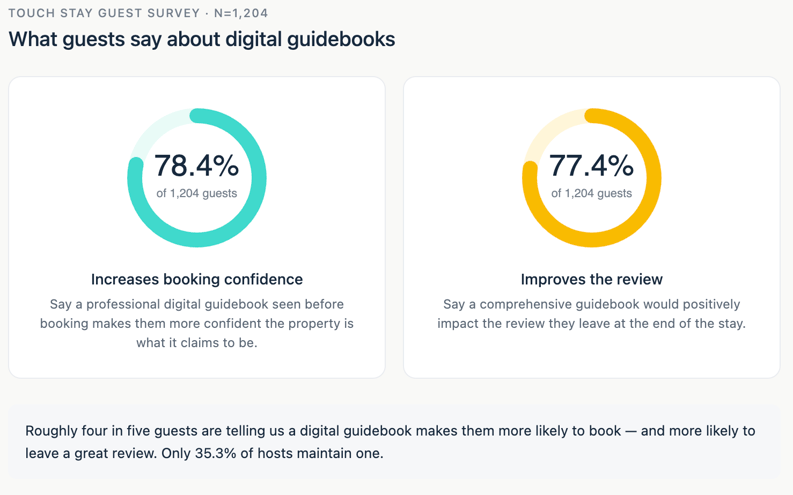
- 78.4% of guests said a professional digital guidebook before booking would increase their confidence in the property (43.6% "yes, significantly" + 34.8% "somewhat")
- 77.4% said a comprehensive digital guidebook would positively impact the review they leave (48.0% "yes, definitely" + 29.4% "probably")
Roughly four in five guests are telling us a digital guidebook makes them more likely to book and more likely to leave a great review. That isn't a niche preference. It's a structural expectation. The 88.7% demanding detailed check-in instructions are not asking for a longer WhatsApp message. They are asking for content of a depth and structure that no messaging channel can hold.
Now compare guest expectations to how hosts actually deliver:
- 72.3% use email
- 56.2% use manual emails, texts, or calls
- 44.9% use printed guidebooks
- 41.9% do in-person briefings
- Only 35.3% use a digital guidebook or app
The mismatch is most acute around printed materials. 44.9% of hosts use them. 0.5% of guests want them. Printed guidebooks are not a guest experience tool, they're a host comfort tool. They make the host feel they've covered things. The guest has already opened their phone.
But the more interesting gap is the inverse one. Fewer than four in ten hosts maintain a digital guidebook, while roughly eight in ten guests say one would make them more confident booking and more likely to leave a five-star review. That gap is the opportunity.
The best-performing setup we see treats notification and information as two layers, not one:
- Send a WhatsApp or platform message 24 hours before arrival with a tight summary plus a link to the full guidebook — this is the alert
- Maintain a mobile-first digital guidebook as the single source of truth for check-in instructions, WiFi, appliances, house rules, and local recommendations — this is the information
- Place a single physical card at the property with the WiFi and the guidebook link — for guests who lose the email
The message gets the guest's attention. The guidebook holds the depth. The card rescues anyone who clears their inbox. None of these compete with each other — they layer.
This structure also solves the operator-side problem that the survey surfaced quietly: when check-in details, parking, or appliance instructions change, you update one place, not seven. The 56.2% of hosts still doing manual emails, texts, or calls are not just delivering information in the wrong channel — they're maintaining the same content in multiple places and watching it drift out of sync.
Where most hosts are missing a clear revenue lever
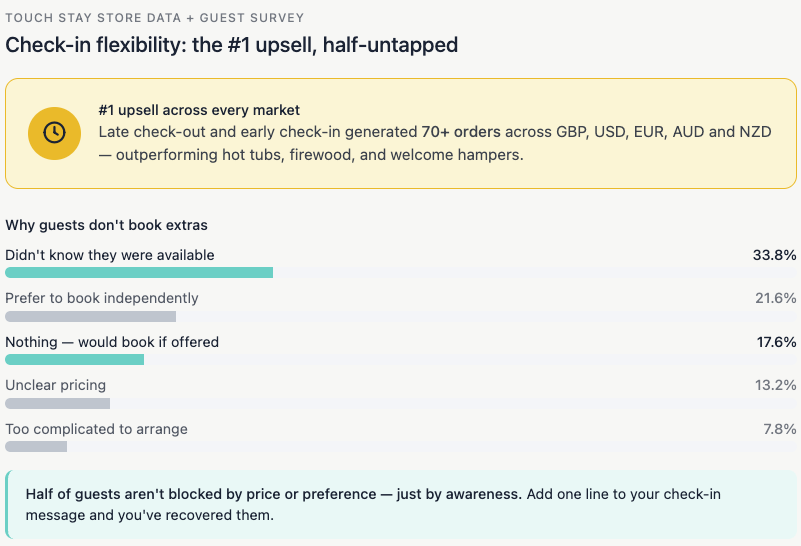
This part surprises people. Across 385 upsell orders we analysed from Touch Stay's Store data, the single most common purchase across every market and every property type was the same:
Flexible check-in and check-out.
Late Check-out alone accounted for 37 orders. Early Check-in added 18. Together with their variants, check-in flexibility products generated more than 70 orders across GBP, USD, EUR, AUD, and NZD — outperforming hot tub prep, firewood, welcome hampers, and pool heating. It is the only upsell that consistently converts in every market we measured.
And yet, when we asked guests in the survey what stops them from booking these add-ons:
- 33.8%: "Don't know they're available"
- 21.6%: Prefer to book independently
- 17.6%: "Nothing — I would if offered"
- 13.2%: Unclear pricing
- 7.8%: Too complicated to arrange
More than half of guests would book extras — they just don't know they exist or can't see clear pricing. This is the easiest revenue you will ever recover. Add a line to your check-in instructions message:
"Need a later check-out? You can add it directly here for $20 — subject to the next guest's arrival time."
That single sentence converts. It costs you nothing. It also pre-empts the awkward "is there any chance we could check out at 1pm?" message you'd otherwise have to negotiate manually. (Touch Stay's upsell widget handles the pricing, availability check, and payment in one tap, so guests don't have to message you at all.)
A check-in instructions message template that actually works
Templates are everywhere. Most of them are too short. Here's one informed by what guests actually ask:
Hi {first_name},
We're looking forward to hosting you at {property_name}. Check-in is from 4pm. If you'll arrive earlier, you can store luggage at the property from 12pm — just reply to let me know.
Getting there Address: {address} Exact entrance pin: {google_maps_link} Parking: One free spot at the front. If it's taken, there's free street parking on Oak Lane (1 minute walk).
Getting in 1. The lockbox is on the wall to the right of the green front door (photo: {link}) 2. Code: {access_code} 3. Turn the dial right until it stops, then pull down 4. Inside the box: front door key and a welcome card
First five minutes Light switch is on your left as you walk in. The alarm panel will beep — enter {alarm_code} within 30 seconds. WiFi: network "{wifi_name}", password "{wifi_password}" (also on the card by the kettle).
One quick note The dishwasher is sensitive — please don't run it overnight. Everything else: go for it.
Need anything? Message me here or on WhatsApp: {phone}. Reply time is usually under an hour during the day.
Optional extras Late check-out (until 1pm): $20. Welcome hamper: $30. Just reply and I'll add it.
Full house guide: {guidebook_link}
See you soon, {host_name}
This template does five things the standard versions don't:
- Answers questions before they're asked — early arrival, parking backup, alarm panel
- Uses a visual — a photo of the lockbox location
- Sets channel expectations — where to message, how fast they'll hear back
- Surfaces revenue — extras priced and one-tap available
- Links the durable source of truth — the full guidebook, not embedded in the message
The check-in instructions checklist
Use this as a final pass before sending:
- [ ] Exact arrival time window stated, with the "what if I'm early" path covered
- [ ] Address and a pin-drop link to the actual entrance
- [ ] Parking instructions with at least one backup option
- [ ] Step-by-step access instructions including a photo of the lockbox/keypad
- [ ] What to do in the first 60 seconds after entering (lights, alarm, WiFi)
- [ ] WiFi credentials visible in the message itself, not buried in an attachment
- [ ] One property-specific "please don't" stated kindly
- [ ] Direct contact for the host, plus typical reply time
- [ ] Optional extras (late check-out, early check-in) priced and offerable
- [ ] A link to a mobile-first digital guidebook for everything else
- [ ] Sent via the channel the guest prefers (default: WhatsApp or platform; not email-only)
The bigger picture
Check-in is the easiest part of the guest experience to systematize and the hardest part to recover from when it goes wrong. Our data says guests demand detail (88.7% of them, by an enormous margin), that most hosts deliver through channels guests don't want (printed and email-first), and that the moment of arrival generates more support questions than any topic except WiFi.
It also says, quietly, in the upsell numbers, that hosts who frame check-in as a flexible, optional experience rather than a fixed window are unlocking the most reliable add-on revenue in the industry. The host who sends "we're ready for you from 4pm, but early check-in is $15 if you'd like it" is not just answering a question. They're monetising one.
Want to send check-in instructions guests actually read and act on? Touch Stay's digital guidebooks put everything they need on their phone, in the channel they prefer, with optional add-ons built in.