

Summarize in
The short-term rental (STR) industry continues to mature at breakneck speed. What started as a side hustle for many has rapidly professionalized, demanding sophisticated tools to manage everything from channel distribution and dynamic pricing to guest communication and housekeeping rotas.
In 2026, relying on spreadsheets and manual calendar updates is no longer a viable path to profitability.
Whether you manage a single holiday cottage or a sprawling portfolio of serviced apartments, short-term rental management software or a ‘Property Management System’ (PMS) is now the backbone of any successful hosting business.
To help you cut through the noise, we’ve compiled a definitive list of the 10 best short-term rental management software platforms available in 2026.
Here’s what we'll cover:
- What is short-term rental management software?
- Why is short-term rental software important for hosts?
- How to choose the best short-term rental software for your properties?
- Top 10 short-term rental software in 2026
- Key takeaways
Tired of answering the same guest questions repeatedly? Stop stressing over check-in details and local recommendations. Touch Stay guidebooks save you hours every week while delivering a 5-star guest experience.
What is short-term rental management software?
Short-term rental management software is an all-in-one digital platform designed to automate and streamline the day-to-day operations of managing holiday lets, vacation rentals, and serviced apartments.
In essence, a Property Management System (PMS) centralises tasks that would otherwise be handled manually across multiple platforms. This typically includes a channel manager to sync availability across platforms like Airbnb, Vrbo, and Booking.com; a unified inbox for guest communication; tools for managing housekeeping and maintenance schedules; and sophisticated accounting features for reconciling bookings and generating owner statements.
The best platforms act as a mission control for your business, ensuring pricing is optimised, guests are responded to promptly, and your team is fully organised, all from a single dashboard.
Why is short-term rental software important for hosts?
This isn't just theory, it's what Touch Stay's customer relations team hears directly from hosts and property managers every day. Whether someone runs one property or fifty, the same benefits come up: saving time, managing multiple properties efficiently, automating guest communication, centralizing operations, and scaling without scaling the workload.
1. Eliminating the risk of double bookings
A reliable channel manager is perhaps the most critical component. By automatically syncing your calendar and rates across all major Online Travel Agencies (OTAs) and your direct booking site in real-time, the software removes the almost guaranteed risk of overbooking that comes with manual management. This protects your reputation and prevents costly cancellations.
Check out our popular webinar on achieving independence from OTAs
2. Boosting revenue through dynamic pricing
Modern STR software integrates with, or includes, dynamic pricing tools. These programmes constantly analyse market demand, competitor rates, local events, and seasonal trends to automatically adjust your nightly prices.
This approach helps you capture strong revenue during peak demand and stay competitive in the shoulder season, which leads to higher occupancy and a stronger Average Daily Rate (ADR).
Pro tip: discover how to use dynamic pricing (and other strategies) to maximise your STR revenue
3. Automating guest communications
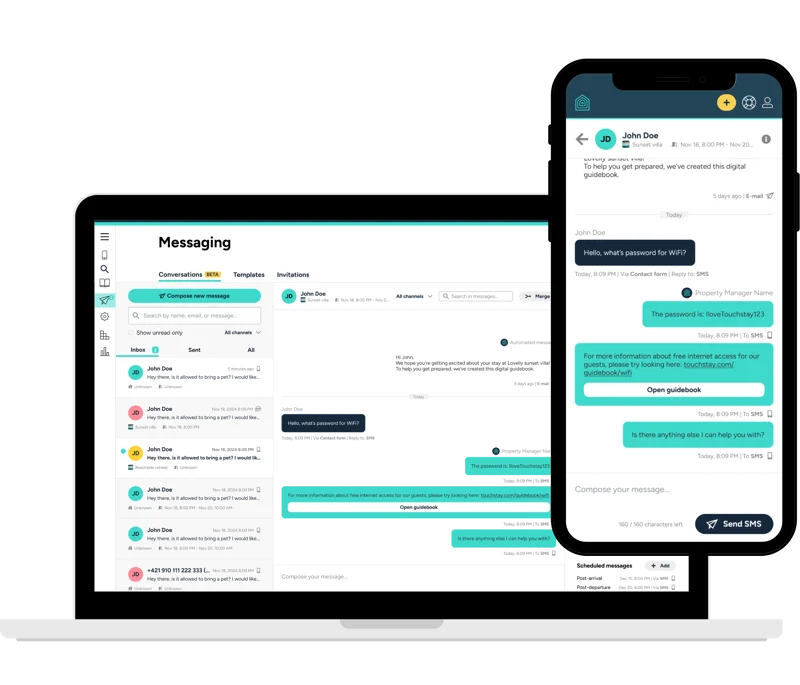
Guest communication is time-consuming yet essential for positive reviews. Top-tier software includes automation features that handle 90% of routine interactions such as sending check-in instructions, Wi-Fi codes, pre-arrival surveys, and post-stay review requests. A unified inbox consolidates messages from all channels, ensuring you or your team never miss a vital query.
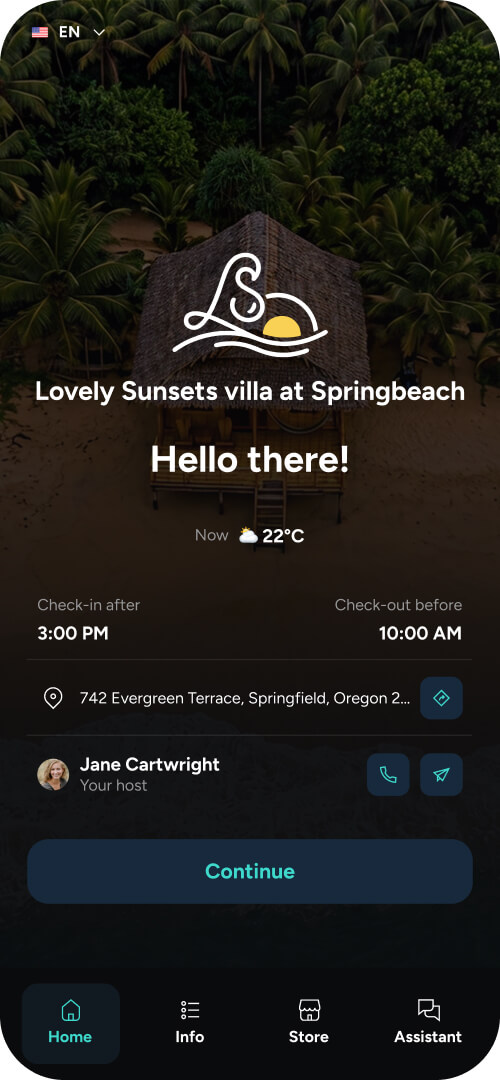
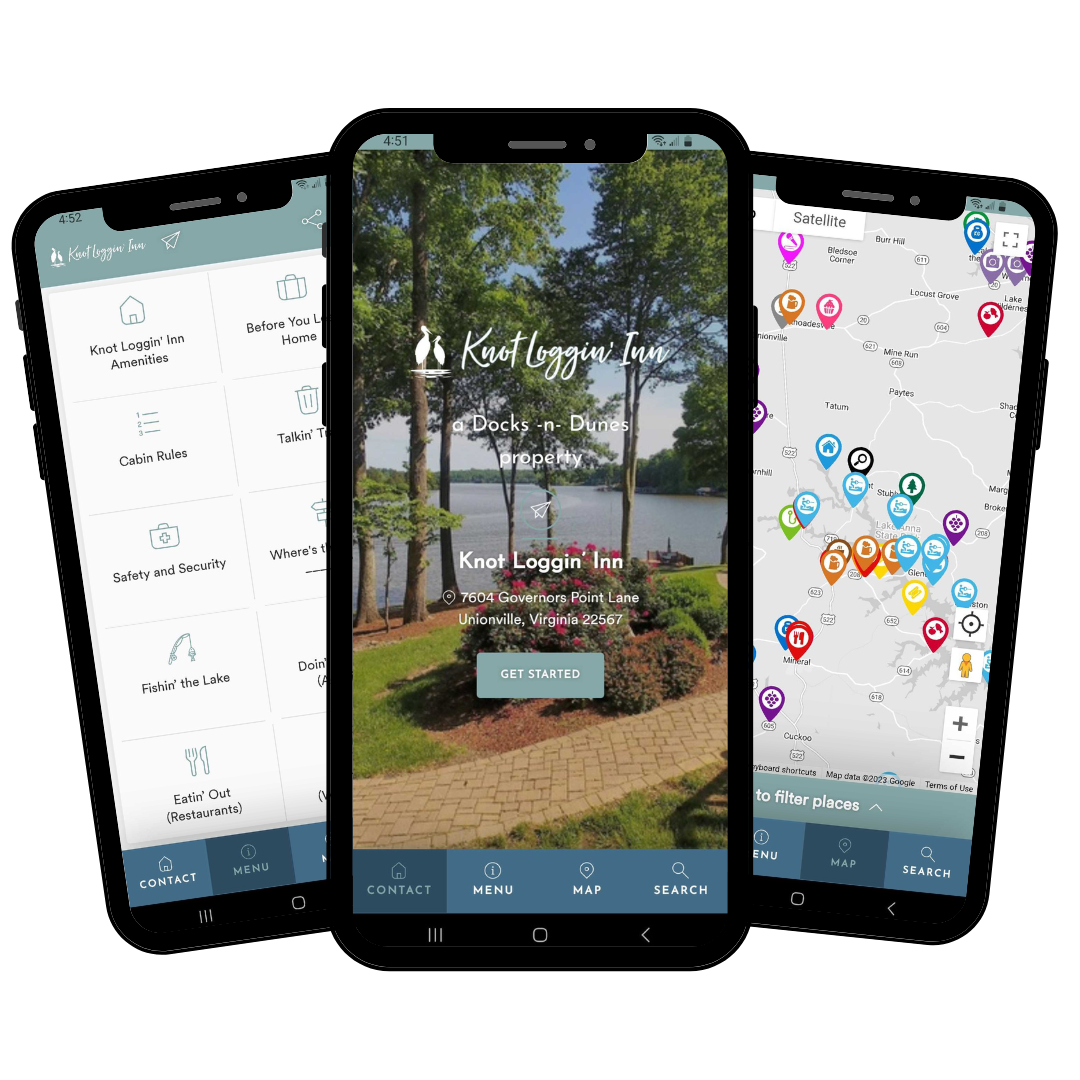
This is where the right software stack actually matters. Your PMS can take care of sending the messages, but a tool like Touch Stay makes the content itself clear, attractive, and easy for guests to use.
House rules, directions, and local tips stay updated and available on their phone at any time, which cuts down the number of repeated questions you have to answer.
4. Streamlining operations and team management
For property managers with multiple units, organising cleaning and maintenance is a huge logistical challenge. STR software automates task assignment based on check-out times, tracks task completion via a mobile app, and alerts team members to unexpected issues, ensuring fast guest turnovers and happy housekeepers.
5. Achieving financial clarity
Managing financials for multiple properties and owners requires robust accounting. The software simplifies trust accounting, tracks expenses, handles payment processing, and automatically generates transparent and professional owner statements, allowing you to focus on growth rather than tedious bookkeeping.
How we evaluated this list
To build this list we combined three sources: first-hand experience as a Touch Stay integration partner with many of these platforms (we see how the connections actually behave, not just how they're marketed); direct, day-to-day feedback our customer relations team hears from hosts; and public data — G2 and Capterra ratings, published pricing pages, and vendor documentation.
A few honesty notes: we didn't run a paid trial of every tier of every platform, so treat pricing as a strong approximation and confirm directly with the vendor before signing up. And because Touch Stay integrates with most of the platforms below, we're not a fully neutral third party; where we have direct first-hand insight into how an integration performs, we've called it out explicitly rather than letting it blend into generic copy.
We weighed each platform against five criteria:
|
Criteria |
Weight |
What we're checking |
|
Core features & automation |
25% |
Channel manager reliability, guest messaging automation, depth of housekeeping/ops tools |
|
Integrations & API depth |
20% |
Marketplace breadth, API access, real-world sync behaviour with pricing tools, locks, guidebooks |
|
Pricing & value transparency |
20% |
Clarity of published pricing, hidden fees, whether a custom quote is required |
|
Support quality |
15% |
Responsiveness per public reviews and availability of 24/7 support |
|
Scalability |
20% |
Ability to handle portfolio growth without a disruptive migration |
Note: this is the framework we used, not computed per-platform scores. We haven't audited every plan tier closely enough to assign a defensible numeric score to each. Publishing literal per-platform scores would need a dedicated testing pass first.
How to choose the best short-term rental software for your properties
Selecting the perfect software is a strategic decision that requires careful evaluation of your specific business needs. The platform that works for a single host managing two flats in London might not be suitable for a management company overseeing a hundred villas in the Algarve.
Here are the critical factors to consider:
a) Pricing
Software pricing models vary significantly. Some charge a fixed monthly fee per unit, others take a percentage of your booking revenue, and some are based on a tiered subscription structure covering a set number of units. You need to calculate the total cost based on your current portfolio size and projected growth.
b) Features
Prioritize the features that solve your biggest pain points. If direct bookings are a core focus, a platform with a high-quality integrated website builder is essential. If you manage properties for others, trust accounting and an owner portal are non-negotiable.
c) Integrations
No single software does everything perfectly. A strong API and a thriving marketplace of integrations are crucial. For property managers with unique workflows, custom real estate app development can create tailored solutions that integrate directly with existing PMS platforms. Check if the PMS connects with your other essential tools, such as dynamic pricing providers (like PriceLabs or Beyond), smart locks (like August or Yale) and dedicated digital guidebook services (like Touch Stay).
A platform with a poor integration record will create new, frustrating manual workarounds.
d) Support
When a booking channel goes down or a payment fails, 24/7 support is key. Look for platforms that offer dedicated onboarding support and accessible help centres.
Read independent reviews on Capterra and G2 to gauge the quality and responsiveness of their customer service team, as this is often where the biggest frustrations lie.
e) Scalability
Choose a platform that can grow with you. If you plan to double your portfolio in the next two years, the software should be capable of handling that volume without requiring a costly and disruptive migration to a new system.
Enterprise-level solutions often come with a higher initial cost but offer the infrastructure needed for large-scale management.
Top 10 short-term rental tools in 2026
|
Software |
Best for |
Starting price (approx.) |
|
Airbnb |
Native tools / small portfolios |
Free (host service fees apply) |
|
Hostaway |
Fast-scaling, automation-focused |
Custom quote; ~$40/listing small scale, less at volume |
|
Lodgify |
Bookings & websites |
From ~$16/mo per property (see booking-fee note) |
|
Guesty |
Large / enterprise portfolios |
Custom quote |
|
Hospitable |
Automation-first, small-to-mid |
Free (Essentials); paid from $29/mo (Host) |
|
LiveRez |
Established mid-sized US PMs |
Custom quote; est. ~$350–550/mo |
|
RMS Cloud |
Multi-property hospitality groups |
Custom quote; ~$55/mo aggregator estimate |
|
OwnerRez |
Accounting & channel control |
From $40/mo (1 property), scales down |
|
DoorLoop |
Mixed STR / LTR portfolios |
From $69/unit/mo (Starter, annual) |
|
Escapia |
High-volume Vrbo/Expedia ecosystem |
Custom quote; ~$9/unit at 100+ units |
Pricing approximate and dependent on unit count, feature tier, and billing cycle. Hostaway, Guesty, LiveRez, RMS Cloud and Escapia no longer publish fixed rates and quote per portfolio. Treat figures as indicative. Last checked: 18th June 2026.
1. Airbnb
Who this is for: Hosts with one or two properties who want native tools without paying for a separate PMS — not a fit once you list across multiple channels.
Airbnb, as the world's leading OTA, offers powerful native tools for hosts managing just a few properties. While not a full, standalone PMS, its Host Platform provides essential features like calendar synchronisation, automated messaging templates and performance analytics.
- Key features: Native booking/payment processing, basic calendar management, resolution centre, smart pricing tool.
- Pricing: Free to use; standard Airbnb host service fees apply. As of October 2025, PMS-connected listings moved to a 15.5% host-only service fee structure.
-
Pros: Strong integration with the largest STR market; free of charge.
- Cons: Limited automation; requires external PMS for true multi-channel management; basic accounting.
What we hear from hosts: the most common feedback is about fees and the sense that Airbnb owns too much of the guest journey, communication, data, and upsell opportunities. Airbnb has its own guidebook feature, but hosts often prefer a dedicated digital guidebook for the flexibility, branding control, and richer content.
2. Hostaway
Who this is for: Property managers scaling fast across multiple channels who want heavy automation and can handle a steeper learning curve.
Hostaway is renowned for its powerful channel manager and comprehensive automation suite, making it a favourite for property managers looking to scale rapidly. It features a unified inbox and 24/7 support.
- Key features: Industry-leading channel manager, AI-driven automation (messaging, pricing), central calendar, unified inbox, 24/7 phone support.
- Pricing: Custom quote only — Hostaway no longer publishes fixed rates. Operators reported roughly $40 per listing per month at small scale in 2026, dropping toward the high teens per listing as portfolios grow, usually with a one-time onboarding fee.
- Ratings: Highly rated on major platforms like G2 and Capterra (around 4.7/5).
- Pros: Exceptional reliability for synchronisation; strong automation saves significant time; dedicated support.
- Cons: Pricing can be opaque for smaller businesses; high learning curve due to feature depth.
3. Lodgify
Who this is for: Hosts who want to reduce OTA dependence and build a professional direct-booking website without an enterprise-grade PMS.
Lodgify stands out for empowering hosts to build professional, commission-free direct booking websites easily. It is an all-in-one solution perfect for hosts eager to reduce reliance on OTAs and build their own brand.
- Key features: Integrated website builder and direct booking engine, channel manager, AI and automation tools, payment processing.
- Pricing: Per-property subscription from ~$16/month (billed annually) at entry.
- Ratings: Well-reviewed across the board (Capterra score of 4.4/5), and an official Airbnb Preferred+ Software Partner.
- Pros: Excellent for direct bookings; professional-looking website templates; user-friendly for beginners.
- Cons: Channel management depth can sometimes lag behind enterprise competitors; higher subscription tiers are needed to remove booking commissions.
4. Guesty
Who this is for: Large or fast-growing portfolios needing enterprise-grade financial tools and API depth — Guesty Lite extends this to smaller hosts.
Guesty is one of the most recognised STR platforms, offering enterprise-level tools for managers with large or complex portfolios. It also provides Guesty Lite, a streamlined version designed for solo hosts and small portfolios, giving smaller operators access to essential automations and integrations (including the Marketplace featuring Touch Stay).
-
Key features: Comprehensive channel manager, advanced automation (ReplyAI), GuestyPay, robust Owner Portal, Trust Accounting (add-on), API for extensive integrations, plus Guesty Lite for simplified small-portfolio management.
-
Pricing: Custom quote for most users; Guesty Lite offers a lower-cost entry point. No fixed rates published. Ratings: Strong global ratings (4.5/5 on G2).
-
Pros: Enterprise-level capability for scaling; powerful financial tools; Guesty Lite expands accessibility to smaller hosts.
-
Cons: Full platform may be too complex or costly for smaller managers; onboarding can be time-intensive.
5. Hospitable
Who this is for: Automation-first hosts who want a no-frills start (the new Essentials plan) with room to add dynamic pricing and direct booking later.
Hospitable champions an automation-first approach, making it an excellent choice for hosts who want to minimise manual tasks and reclaim their time. The platform excels in streamlining guest communication with AI-powered messaging and automated workflows. In 2026, Hospitable also introduced a brand-new Essentials plan with no monthly subscription fee, making it one of the most accessible ways to get started with a professional PMS.
- Key features: AI-powered messaging automation, channel manager (Airbnb, Vrbo, Booking.com, Google Vacation Rentals), built-in dynamic pricing (free), direct booking website builder with $5M damage protection, smart lock integrations, unified inbox.
- Pricing: Four tiers, billed annually — Essentials ($0, unlimited properties, core tools but no AI assistant); Host ($29/mo); Professional ($59/mo); Mogul ($99/mo for 3 properties, then ~$30/mo per additional property). 14-day trial on paid plans.
- Ratings: Exceptionally high user satisfaction (4.8/5 on G2 and Capterra).
- Pros: Outstanding automation saves significant time; built-in dynamic pricing at no extra cost; transparent, affordable pricing; excellent customer support.
- Cons: Enterprise-level features may be limited compared to larger platforms; direct booking website builder has some customisation limitations.
6. DoorLoop
Who this is for: Managers juggling a mixed short-term and long-term rental portfolio who need strong accounting above all.
While traditionally focused on residential and commercial property management, DoorLoop has expanded aggressively into the STR space. Its strength lies in its powerful, user-friendly accounting features, making it ideal for managers with mixed portfolios requiring tight financial controls.
- Key features: Comprehensive accounting (trust accounting, expense tracking), online payment collection, tenant/guest screening, maintenance request tracking, owner statements.
- Pricing: Starter from $69/unit/mo billed annually ($79 monthly) per DoorLoop's own page, covering the first 20 units with a small per-unit fee above that. Some third-party listings cite lower entry figures ($49–$59). Pro and Premium run higher.
- Ratings: Excellent average rating of 4.8/5 across major review sites.
- Pros: Best-in-class accounting and financial reporting; very easy-to-use interface; strong, human-led support.
- Cons: STR-specific features (like dynamic pricing integration depth) are still developing compared to pure-play vacation rental systems.
7. LiveRez
Who this is for: Established mid-sized US-based managers who value a proven trust-accounting core over the newest interface.
LiveRez has been a foundational name in the vacation rental industry, particularly among mid-sized US-based managers. It is known for its strong direct booking features and trust accounting core.
- Key features: Integrated booking engine and websites, trust accounting, maintenance and operations platform, reservation grid (unified calendar).
- Pricing: Custom, quote-based — no published rates. Third-party reviews estimate ~$350–550/month depending on portfolio, with setup costs on top.
- Ratings: Reputable track record in the industry (around 4.0/5 on Capterra).
- Pros: Tried-and-true platform with strong longevity; excellent for direct booking functionality.
- Cons: Requires a significant upfront investment; the platform’s future is subject to market consolidation, causing some user uncertainty.
8. RMS Cloud
Who this is for: Larger hospitality operators — hotels, serviced apartments, parks — needing a system built for multiple property types.
RMS Cloud is a global leader, heavily focused on the wider hospitality sector, including hotels, parks, and serviced apartments. It is an enterprise-grade solution best suited for large, established management companies operating multiple types of property.
- Key features: Comprehensive property management and operations, guest experience portal, robust communication hub, advanced rate management, owner and trust accounting (add-on).
- Pricing: Custom, quote-based — RMS Cloud does not publish rates and tailors quotes by property size and type. Aggregators cite a ~$55/month starting point. Free demo, no free trial.
- Ratings: Highly regarded in the hospitality sector (around 4.3/5 on Capterra).
- Pros: Built for high-volume, multi-site management; excellent integration for non-accommodation services.
- Cons: Overkill for small hosts; the pricing structure is complex and requires custom negotiations.
9. OwnerRez
Who this is for: Hosts who want strong accounting and direct channel control without giving up a percentage of revenue.
OwnerRez is highly valued by hosts for its strong, direct integration with channels like Airbnb and Vrbo, offering robust accounting and messaging without taking a percentage of revenue. It is particularly popular in the US market.
- Key features: Trust accounting, direct channel management (no % fees), integrated websites, dynamic messaging (email/SMS/channel) and CRM.
- Pricing: Per-property model with a $40/month minimum (covers 1 property), scaling down per-property as you add more. No setup fees, no booking fees, no contracts. 14-day trial.
- Ratings: Exceptionally high user satisfaction (4.8/5 on G2 and Capterra).
- Pros: Outstanding value for money; powerful accounting functionality; transparent, per-property pricing.
- Cons: User interface is functional but less sleek than newer platforms; reliance on integrations for certain advanced features.
10. Escapia
Who this is for: High-volume managers deeply embedded in the Vrbo/Expedia ecosystem who prioritise proven financial reliability.
Escapia is a key player within the Expedia Group (Vrbo/HomeAway) ecosystem, making it a go-to choice for established property managers who derive a significant portion of their business from Vrbo and its partners.
- Key features: Battle-tested Trust Accounting, expansive distribution (30+ fee-free direct connections), maintenance management, automated guest hospitality application, Owner Portal.
- Pricing: Flat monthly fee based on unit count, custom-quoted. Published figures indicate ~$9 per unit at the 100+ unit level; smaller portfolios pay more per unit.
- Ratings: Very high satisfaction for its core financial and distribution capabilities.
- Pros: Deeply integrated with the Vrbo/Expedia network; proven reliability in financial management; robust Owner Portal.
- Cons: Primarily designed for high-volume professional managers; its user interface can feel dated compared to newer, nimbler competitors.
Ready to unlock more time and improve your guest reviews?
A great Property Management System gets the booking, but a digital guidebook ensures the stay is seamless. See how thousands of hosts use Touch Stay to reduce questions by up to 80%.
Key takeaways
The short-term rental management software landscape in 2026 is defined by powerful automation, deep financial reporting, and a shift towards empowering hosts to drive direct bookings.
-
For massive portfolios, Guesty or Escapia offer the enterprise-level infrastructure and comprehensive accounting required.
- Mid-sized managers focused on growth will find Hostaway to be an excellent, scalable choice.
- For automation-focused hosts wanting to save time without complexity, Hospitable delivers outstanding value with AI-powered messaging and free built-in dynamic pricing.
- If your primary goal is building your own brand and escaping OTA dependence, Lodgify and OwnerRez provide outstanding value and control.
Ultimately, the best PMS is the one that best integrates with your specific workflow. No matter which platform you choose, remember that the most successful short-term rental businesses combine robust back-office operations (managed by your chosen PMS) with an unparalleled guest experience. This seamless experience begins the moment a guest books and continues until they leave a 5-star review.
Don't let manual guest communications clog up your new, efficient system. Enhance the stay, reduce the questions, and save yourself hours of administrative time by providing a stunning, digital welcome book.
Want to improve your guest experience and stop answering the same questions over and over? Touch Stay works seamlessly alongside all the PMS options listed above.