

Summarize in
Quick Answer (TL;DR)
A vacation rental business plan is your roadmap for launching and growing a profitable short-term rental. It helps you define your goals, choose the right business model, understand your market, plan your finances, and attract investors. By researching your audience, analyzing competitors, setting SMART goals, and building a solid marketing and operations strategy, you can reduce risk and scale your rental business with confidence.
According to Statista, the vacation rental market is projected to reach $105.71 billion globally in 2026. In such a scenario, starting a vacation rental business can be an exciting and lucrative venture. However, without a clear plan, it’s easy to get lost in the details.
A vacation rental property business plan serves as your roadmap, outlining your goals, identifying your target guests, mapping out your marketing and operations strategies, and helping you understand your financials. It’s also a vital tool if you’re looking to secure funding or bring on business partners.
In this step-by-step guide, we’ll walk you through everything you need to know to create a vacation rental property business plan, so you can launch your business with confidence.
Table of contents:
- What is a vacation rental business plan?
- Business plan vs. vacation rental business model: What’s the difference?
- Why is a vacation rental business plan important?
- How to create a vacation rental business plan
- Vacation rental business plan template
- Tips and tricks for vacation rental business plans
- Common mistakes to avoid in a vacation rental business plan
- Frequently asked questions
What is a vacation rental business plan?
A vacation rental business plan outlines your goals for running a short-term rental property and a set of rules and practices to guide you when making decisions.
It is like a roadmap that will help you stay organized, make informed decisions, and prepare for unexpected challenges.
Even if you’ve been managing rentals for years, an up-to-date business plan can help you identify new opportunities or areas for improvement. According to a study, businesses with a plan were found to grow 30% faster than those without one.
Business plan vs. vacation rental business model: What’s the difference?
It is easy to confuse a business model with a business plan. While the two are closely related, they serve different purposes.
A vacation rental business model serves as a blueprint for how your vacation rental makes money. It answers questions like:
- Who are your customers?
- What value are you offering them?
- How do you deliver that value?
- How do you earn revenue?
For example, if you’re renting out luxury apartments in a ski town, your business model might focus on targeting high-income travelers during peak seasons, with premium pricing, and concierge-style service. On the other hand, if you own apartments in the city, you can take a volume-based approach, offering budget-friendly stays year-round via Airbnb and Booking.com.
A business plan, on the other hand, outlines how you’ll bring your business model to life. It includes specific goals, market research, marketing strategies, financial projections, and action plans.
Why is a vacation rental business plan important?
By creating a business plan, you are putting your goals onto paper, alongside the actions you can take to achieve those goals. Here are the top 4 reasons why you need a well-prepared business plan.
Secure financing
A business plan shows banks and potential investors that you understand the market, have a strategy and can turn a profit. It also outlines how much funding you need, what you’ll use it for, and how and when they can expect returns. This makes it easier to convince investors to back your vision financially.
According to studies, entrepreneurs who create a formal business plan are twice as likely to secure funding compared to those who don’t.
Plan for the long-term
A business plan encourages you to think about where you want your business to be in the next 1, 3, and even 5 years. It also lays out the steps needed to get there and prepares you for challenges on the way, like market downturns, seasonal shifts, or regulatory changes.
Set clear goals
Whether it’s earning a specific monthly income, achieving a certain occupancy rate, or maintaining a high guest rating on platforms like Airbnb, a business plan helps you define what success looks like for you. These goals give you something to work towards and help you track your progress over time.
Budget with confidence
Creating a business plan involves laying out your projected income, expenses, and profits, which helps you avoid overspending, allocate your resources wisely, and understand when you’ll break even or turn a profit.
How to create a vacation rental business plan
Creating a vacation rental business plan might sound overwhelming. If you don’t know where to begin, use the following step-by-step guide.
1. Do your research
The first step to creating a business plan is understanding the landscape you’re stepping into. This means asking yourself several questions that will help you understand the market, your competitors, your target audience, and the local regulations.
- Are travelers visiting year-round or only during certain seasons?
- Is there a strong tourism industry or is it demand driven by business travelers or events?
- What type of properties are most popular?
- How are similar vacation rentals priced?
- What amenities do they offer?
- What kind of guests do you want to attract?
- Do you require a license to run a vacation rental?
- Should you pay taxes?
- Are there zoning restrictions?
You can use platforms like AirDNA, Mashvisor, and Lighthouse to access data on occupancy rates, average daily rates, and revenue potential for specific areas. In addition, checking your city or municipality’s website, or speaking to a local real estate attorney, will give you insights into the local laws surrounding short-term rentals.
2. Choose your business model
Now that you’ve done your research, the next step is choosing a business model that fits your goals, budget, and lifestyle. Some of the most common vacation rental business models include:
Owner-operated model
You own the property and manage all aspects of the rental yourself. This model is best for full-time hosts or those with a small number of properties because it requires upfront investment and ongoing involvement. However, since you own the property you’re in full control and can enjoy higher profit margins.
Rental arbitrage
If you want to start a rental business without a huge investment, you can lease a property and re-rent it as a short-term vacation rental (usually with the landlord’s permission). Nonetheless, this model tends to be riskier, particularly when bookings are low.
Property management
Unlike the last two models, here you manage short-term rentals on behalf of the property owners. In return, you charge a management fee or take a commission from bookings. This is a good option for experienced hosts looking to grow a service-based business, but the profit per property tends to be lower.
The business model you choose should depend on factors like your startup capital, risk tolerance, and long-term vision. Pick a model that works not just for one property but also for the additional ones if you plan to scale in the future.
3. Write a summary
A business summary gives the reader a snapshot of what your business is all about.
It includes information about the model you’ve chosen, the services you offer, the people you target, industry insights, short- and long-term goals, etc. You should also include your mission and vision statement in the summary. The mission statement explains what your business aims to do right now, while the vision statement is about where you see the business in the future.
If you’re seeking funding, you must state how much capital you need and what it will be used for.
Most business owners choose to write their business summary at the very end, because knowing the business inside out makes it easier to pick out the most important details to include in the summary.
4. Prepare business goals
Setting clear, measurable business goals helps you identify the steps you should take to succeed. It will also help you stay focused, track your progress, and make informed decisions as your vacation rental business grows.
To ensure your goals are not vague, use the SMART framework to write them down. Your goals should be:
- Specific – Clear and detailed
- Measurable – You should be able to track the progress
- Achievable – The goals should be realistic based on your resources
- Relevant – The goals should align with your overall vision
- Time-bound – Set a deadline to achieve what you’ve planned
Your SMART goals could be reaching $50K in monthly bookings, expanding to 3 properties within 18 months, or maintaining a 4.9-star average guest rating.
5. Find valuable selling points
Your selling points are unique features that help you stand out in the crowded vacation rental market. They are the reason people happily pay for your service over your competitors.
Here are a few areas where you can find your edge.
- Location – Is your property near the beach, popular hiking trails, or a peaceful rural retreat?
- Amenities – Do you offer fast Wi-Fi for remote workers, a pet-friendly space, or have kid-friendly features?
- Guest experience – Do you offer thoughtful extras, like welcome baskets, personalized local guides, or 24/7 support?
- Pricing – Do you offer competitive pricing while offering more value?
- Niche – Are you targeting a specific group, like digital nomads, families, couples, or eco-conscious travelers?
By knowing your strengths, you’ll be able to weave them into your listing descriptions, website copy, marketing materials, and business plan to attract more guests
6. Execute market analysis
A strong market analysis helps you figure out who your guests are, what they want, and how your business can meet their needs, better than the competition. There are 4 key areas, you should research.
- Target audience – Define your ideal guests. Are they families on summer vacation, remote workers looking for extended stays, couples on weekend getaways, or digital nomads?
- Location – Think about your rental location. Is it a tourist hotspot, an up-and-coming neighborhood, or a hidden gem? What attractions, events, or amenities are nearby? Are there any seasonal patterns that affect demand?
- Competition – Identify similar properties in your area, and analyze their nightly rates, the amenities they offer, and how they market themselves.
- Industry trends – Keep an eye on the short-term rental trends in your area. For example, are travelers prioritizing unique stays (treehouses, cabins, or tiny homes), contactless check-in, or strong Wi-Fi?
7. Analyze your potential customers
The more you know your potential guests, what they value, and how they travel, the better you can tailor your property, pricing, and marketing to meet their expectations.
Start by creating buyer personas that represent your ideal customers. These can be families, couples, remote workers, or even pet parents. Give your personas a name, age, profession, and family. For example, your ideal guest could be Jane Doe, a travel writer in her late 20s, who often travels for work alone.
For Jane Doe to choose your business over your competitors, your rental should offer reliable, high-speed internet, ergonomic furniture, and ideally a home office. It also helps if your property is in a quiet neighborhood.
One tip that can make this process simpler is looking at traveler trends. For example, if couples tend to frequent your location, then that’s potentially a demographic you might want to cater to.
8. Check your competitors
Thoroughly research other vacation rentals in your area that are similar in size, location, style, and amenities. Platforms like Airbnb, Vrbo, and Booking.com are great for this. Then create a comparison chart that includes their USPs, pricing strategy, target audience, minimum stay requirements, amenities, guest reviews, and booking availability.
This will help you identify how you can differentiate your vacation rental from the competition. You might also come across gaps in the market that you could bridge through your services. For instance, if most vacation rentals in the area target families, you might want to focus on attracting digital nomads looking for budget-friendly stays.
9. Create an operations plan
An operations plan outlines how your vacation rental business will run behind the scenes. This includes deciding how day-to-day activities such as cleaning and laundry, restocking supplies, accounting, reservations, and property management will be handled.
If you manage multiple properties, you might want to hire staff to help with these tasks. Property management tools like Hospitable and Hostaway are also great for automating routine messages and streamlining your workflow.
10. Prepare your marketing plan
A marketing plan describes the strategies you’ll take to reach your target audience and have them book your property.
A website helps improve visibility on search engines through blog posts, travel guides, and paid ads. In addition, you can market yourself on social media platforms like Instagram and Facebook by sharing behind-the-scenes content, showcasing local attractions, and running promotions to reach your target audience and build a loyal following.
Good marketing should continue through the guest experience, and not stop after someone books. A great way to enhance that experience, and earn glowing reviews is by providing clear, helpful information.
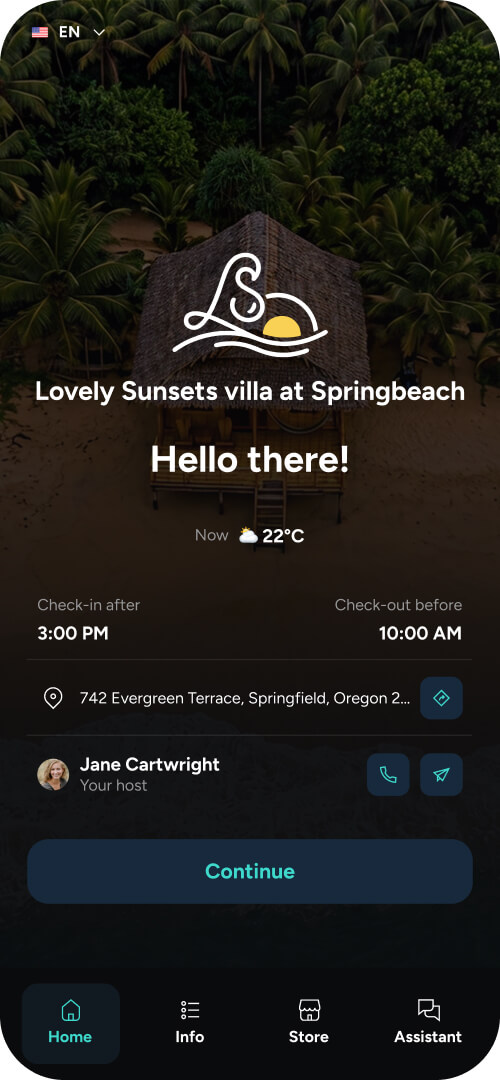
TouchStay is a digital welcome book platform that lets you create personalized guides for your guests. Instead of printing binders or answering the same questions repeatedly, you can send guests a sleek, mobile-friendly guide with all the information they need, such as check-in instructions, house rules, local recommendations, Wi-Fi passwords, appliance guides, and more. It’s professional, easy to update, and saves you time while boosting guest satisfaction.
11. Set up a management plan for your employees
If you plan to grow your vacation rental business beyond a one-person operation, having a clear management plan for your team is essential.
This section should define the roles you need to fill. For example, a housekeeper might be responsible for cleaning and resetting the property between bookings, while a property manager might oversee guest communication, check-ins, and issue resolution. Once the roles are clear, set expectations around work hours, response times, quality standards, and communication protocols. This helps avoid misunderstandings and keeps everyone aligned with your goals.
It’s also a good idea to create checklists, workflows, or even training guides for common tasks. This way, if someone is unavailable or you need to onboard a new hire quickly, there’s already a system in place.
12. Consider your distribution plan
Your distribution plan outlines where and how your vacation rental is seen and ultimately, how it's booked. Research where your target audience goes to book rental properties. For example, Airbnb tends to attract short-term vacationers and millennials, while Booking.com may appeal more to international travelers and business guests.
Create your listings on the sites your ideal guests frequent, and use high-quality, well-lit photos, along with an engaging description that highlights your property’s unique features.
Each platform has different listing fees, features, payment options, and user experience. So weigh the pros and cons carefully, before choosing the best platforms.
13. Prepare your revenue plan
Your revenue plan outlines how you’ll generate income, estimate profits, and ensure your business remains financially sustainable over time. In other words, it’s your understanding of how your business will make money and what it will take to reach your financial goals.
- Nightly rates – Use platforms like AirDNA or Mashvisor to analyze local market data and get a sense of average nightly rates and occupancy levels in your locality.
- Fixed costs – Property taxes, insurance, and mortgage payments.
- Variable expenses – Cleaning services, utilities, maintenance, booking platform fees, and marketing costs.
- Projected income – How much money do you expect to earn in a month?
You might also want to consider using dynamic pricing strategies to maximize your revenue. This means adjusting your nightly rate based on demand, local events, or how far in advance the booking is made. Tools like PriceLabs or Beyond Pricing can automate this process and help you stay competitive.
14. Calculate your financial plan
While your revenue plan focuses on how much money you expect to bring in, your financial plan paints the full picture of your income, expenses, startup costs, and long-term financial health.
- Startup costs – These are usually one-time expenses, such as the purchase price or lease deposit for the property, renovations, furnishings, licenses, photography, website setup, and software tools.
- Operating costs – The recurring monthly or annual expenses that include utilities, cleaning fees, maintenance, property management, booking platform commissions, insurance, taxes, and marketing.
After defining your costs, revisit your income projections from the revenue plan. Then subtract your expenses from your monthly and annual gross revenue to estimate your net profit.
You can create a cash flow forecast (a month-by-month breakdown of income and expenses) to predict when you’ll be in the green, how long it might take to break even, and whether you’ll need to set aside reserves for quieter seasons.
Consider working with an accountant to draft this section so you can be more confident with the numbers and figures.
15. Set up your milestones and KPIs
Milestones are specific goals or achievements you want to reach within a certain timeframe. This could be reaching 75% occupancy within six months, getting your first 100 reviews, or expanding to a second rental unit. They’re typically bigger-picture targets that mark progress toward your overall business goals.
KPIs, on the other hand, are measurable indicators that show how well certain parts of your business are performing. Some useful KPIs include:
- Occupancy rate – How many nights your property is booked?
- Average daily rate (ADR) – How much do you earn per booked night?
- Revenue per available rental (RevPAR) – Revenue earned per available night, whether booked or not
- Guest satisfaction – Average star rating or review score
- Booking lead time – How far in advance people are booking?
- Direct vs. OTA bookings – How many people book directly vs. through platforms like Airbnb or Booking.com
Regularly reviewing your KPIs helps you spot trends, identify problems early, and adjust your strategies. If your guest reviews are slipping, maybe it’s time to revise your cleaning checklist or improve communication. If your direct bookings are low, perhaps your website needs an upgrade or better SEO.
16. Add an appendix
The appendix is the final section of your vacation rental business plan, where you store all the supporting documents and detailed data that would clutter the main sections of your plan. This could be:
- Market research data and reports
- Property photos or renovation plans
- Floor plans or zoning permits
- Sample listings or booking platform screenshots
- Financial projections and spreadsheets
- Legal documents like licenses, insurance certificates, or rental agreements
- Team resumes or bios (if applicable)
- A glossary of terms for readers unfamiliar with vacation rental lingo
- Tools or services you plan to use
The appendix keeps your business plan professional and organized while giving readers the chance to dive deeper if they want to.
Vacation rental business plan template
Grab your free vacation rental business plan template and start your rental journey with confidence.
Our detailed template is designed to help you plan, structure, and build your vacation rental business with clarity. Easily customize it to reflect your goals, and make a strong impression on investors.
Tips and tricks for vacation rental business plans
While the core sections of your business plan lay the foundation, these extra tips can help you refine it and avoid common pitfalls, setting yourself up for long-term success.
Plan ahead
Early planning gives you time to research your market, identify ideal guests, and develop your brand voice. This foresight also helps you navigate challenges like seasonal slowdowns, unexpected costs, or regulatory changes without scrambling.
Be thorough
The more detail you include in the business plan, the clearer your path becomes. For example, don’t just say “I’ll list my property online,” but instead explain which platforms, why, and how you’ll optimize your listing. A well-thought-out plan also gives potential investors or partners confidence in your business.
Take your time
It’s okay if your plan doesn’t come together in a single sitting. Begin with a rough draft, then revisit each section, do more research when needed, and revise your plan as your ideas evolve. It’s better to get it right than to rush through it.
Be open-minded
The vacation rental industry is constantly changing with the emergence of new tech tools, guest expectations, and marketing trends. So, keep an open mind while drafting your plan, and be willing to adjust your plan over time as you gather more data or respond to market shifts. You might discover new business models or services that are a better fit for your goals.
Common mistakes to avoid in a vacation rental business plan
To ensure your vacation rental business plan is on the right track, avoid these common mistakes that can hinder your progress or lead to missed opportunities.
Targeting everyone
While it may seem like a good idea to target every type of guest, the reality is that you’ll likely end up spreading yourself too thin. Instead, focus on those guests who will appreciate your property’s unique features and services. Narrowing your target audience allows you to tailor your marketing efforts and better meet your guests' needs.
Ignoring the competition
Ignoring the competition means you may miss valuable insights into what works (or doesn’t work) in your market. So, research other vacation rentals in your area, paying attention to their pricing, amenities, guest reviews, and booking strategies. This way, you’ll be able to identify opportunities to stand out, whether that means offering a more personalized experience, better pricing, or additional services.
Setting unrealistic goals
Setting goals that are too ambitious or unattainable can quickly set you up for disappointment. Be realistic about your expected occupancy rates, revenue, and growth timelines. For instance, expecting to fully book your property within the first month or generate six-figure profits within a year might not be feasible, especially in the beginning. Break down your goals into smaller, achievable steps, and give yourself room to grow gradually.
[insert another reminder to try Touch Stay for free]
If you want an easier way to boost guest satisfaction and streamline communication, try TouchStay for free and see how it can support your vacation rental goals.
Frequently asked questions
You can build a profitable vacation rental business by carefully choosing a location with strong demand, maintaining competitive pricing, and providing a great guest experience. However, profitability also depends on factors like property management, seasonal demand, and ongoing expenses. So, come up with efficient strategies, and stick with your business plan, and soon you will start seeing profits.
Begin by researching your target market and choosing a property that fits your goals. Then, create a business plan, register your business, and set up your property. Once the property is ready, list it on popular platforms like Airbnb, and Vrbo, or build your own website. From there, focus on marketing, managing bookings, and providing an excellent guest experience to build your reputation and a loyal following.
A 20% to 30% ROI from your vacation rental property is considered a good profit margin. However, this can vary based on factors like location, property expenses, occupancy rate, and pricing strategies.
The profitability of a rental business, whether short-term or long-term, depends on factors such as the type of property, location, and how well it’s managed. Vacation rental properties generally offer higher returns than traditional rentals due to their flexibility and potential for higher nightly rates, but they also require more active management and higher overhead costs.

Ned
Ned has clocked up over 11 years in digital marketing and comms, with a strong focus on creating engaging content for a range of brands and agencies. When he’s not writing, he can be found digging for records, peering through his telescope at the night sky, or onboard his local lifeboat where he volunteers as a crewmember.


Be the first to know!
Join our newsletter for early access to:
- ✅ Free guides
- ✅ Pro tips & tricks
- ✅ Time saving tutorials
- ✅ Latest blog posts
- ✅ Checklists & templates
Thanks for subscribing! You're on the list.