There's a particular kind of hosting advice that shows up every spring. Fresh flowers. A handwritten note. Local chocolate on the counter.
None of it is wrong. It's just not what guests asked for.
In our 2026 guest survey, close to nine in ten guests said they want detailed check-in information before arrival, including access codes and parking. It was the clearest signal in the whole dataset, and it points to the least glamorous hour of the stay: the one between "we're here" and "we're in".
In this article, we'll cover:
Arrival is the only part of the stay with a hard fail state
Most of hosting is graded on a curve. The sofa is comfortable enough. The kitchen has most of what you need. The WiFi is fine.
Arrival isn't like that. Either the guest gets in or they don't. They're tired, often late, sometimes in the dark, usually holding luggage and a phone at 12% battery.
Everything that's charming about your property is irrelevant until the door opens.
That's why arrival information matters so much. It isn't that guests don't care about the rest. It's that the rest doesn't exist yet.
For more on making those first moments smoother, see our guide to creating a seamless self-check-in experience.
What they keep asking for
Across Touch Stay network data, the questions guests put to hosts and guidebooks cluster in the same place year after year. Location and directions come first. Check-in comes second. Then food, amenities, booking questions, WiFi and parking.
Notice that four of those seven are arrival questions.
A useful arrival section covers:
- The route in. Not just the address. Include the turn that's easy to miss, the one-way system and what the building looks like from the street.
- Parking. Give the exact bay or zone, explain permits and include a fallback if the usual space is occupied.
- The entrance. A photo taken at night can be more useful than a perfect daytime shot, especially for late arrivals.
- Access. Explain the code or key location, when it becomes active and the order of operations if there's a gate and a door.
- What to do when it fails. Give guests a real person to contact, a phone number and an honest expectation of how quickly they'll get a response.
That last one gets skipped most often and matters most. Access failures are rare. Access failures with no route to a person are the ones that end up in reviews.
Your digital guidebook can keep these instructions in one place so guests don't have to search through old messages when they arrive.
Send it at confirmation, not the night before
The instinct is to hold arrival details until just before the stay, partly for security and partly because that's when the information feels most relevant.
The problem is that booking windows aren't uniform. Plenty of guests book within a week of arrival, and a pre-arrival message scheduled for seven days out simply never fires for them.
They get nothing.
A better pattern is to send the full guide when the booking is confirmed, then use the pre-arrival message as a reminder that points back to it. Every guest gets the information, whether they booked in January or last Tuesday.
Sensitive entry details can still be released closer to the stay, to the right guest, inside the same guide.
A digital guidebook makes this easier because the link doesn't change. Update the parking instructions once and every guest who already has the link sees the new version.
For more on timing your guest messages, our guest communication guide breaks the stay into pre-arrival, check-in, mid-stay and departure.
The ten-minute test
Hand your arrival instructions to someone who has never been to the property. A colleague, a friend, your cleaner's teenager. Give them only what a guest gets, on a phone, and ask them to talk you through exactly what they'd do from the moment they park.
Watch for the pauses.
Every pause is a missing detail.
The ones we see most often:
- The instructions assume you already know which building is yours.
- The code is there but not when it activates.
- There's a photo of the door in daylight and the guest arrives at 10pm.
- The contact route is "message me on the platform", which is the one app they've closed.
Fix the pauses, then check the whole thing on a phone screen rather than a laptop. If the guest has to zoom, scroll and rotate to read a door code, it isn't finished.
What changes when you get this right
Two things, and they compound.
The obvious one is fewer messages. Arrival questions are some of the most repetitive work in hosting, and many of them are the same twelve questions rotating between guests.
The second is quieter. Guests who get in smoothly start the stay in a good mood, and mood colours everything that follows. The slightly small bathroom, the neighbour's dog, the shower that takes a minute to warm up. You can't control all of those.
You can control whether the guest meets them feeling looked after or already annoyed.
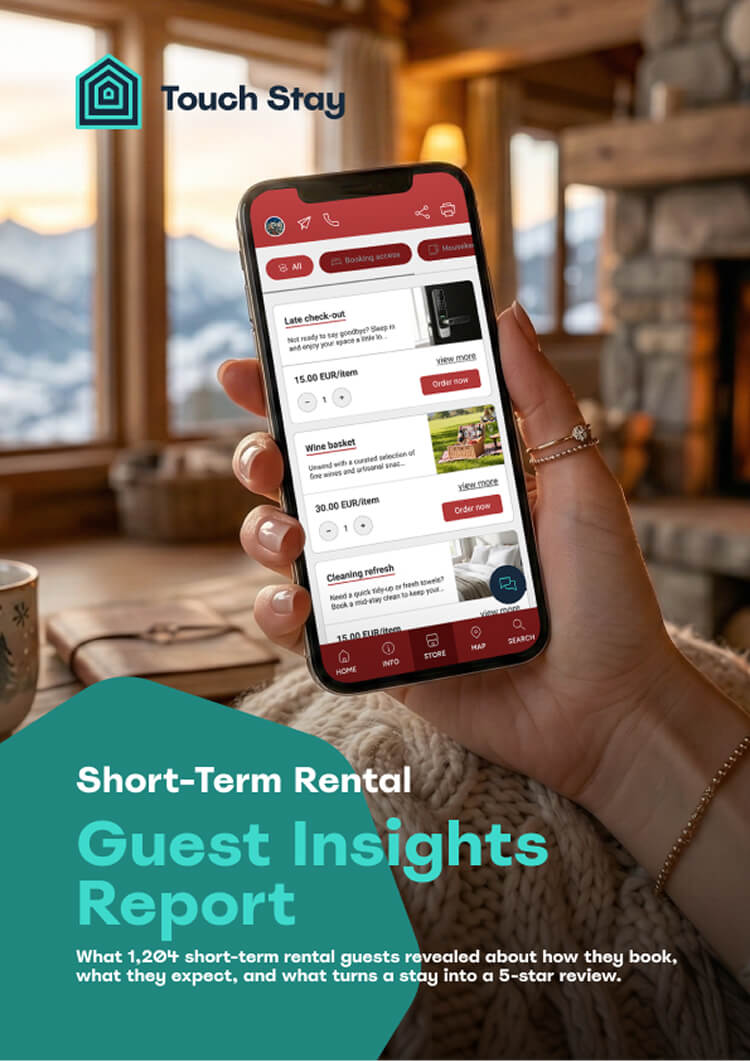
The full arrival data, along with what guests want during the stay and what earns the reviews, is in the 2026 STR Industry Report. It's free and it comes with a checklist you can run on one property.
Findings from Touch Stay's 2026 guest survey of 1,204 short-term rental guests, plus Touch Stay network data on guest questions. Survey carried out in late 2025 and early 2026.