

Summarize in
TL;DR (Quick Answer)
What's the complete guest experience checklist for vacation rentals?
The best approach is a 3-layer system, guest-facing, staff-facing, and management. TouchStay fits the guest-facing layer well, while the checklist itself focuses on listing accuracy, pre-arrival communication, property readiness, check-in, in-stay support, checkout, and post-stay follow-up.
Key Takeaways
- The listing sets the tone before check-in, and it needs to match the real property.
- Pre-arrival messages should be short, timed, and easy to find again.
- TouchStay works as a single digital guide for house rules, Wi-Fi, check-in details, and local tips.
- Property readiness depends on room-by-room turnover, stocked basics, and safety checks.
- Check-in should be tested end to end, including directions, lighting, access codes, and backup support.
- Post-stay review data should feed back into operations, not just reputation tracking.
In this article, we'll cover:
-
Why guest experience is really a trust and reliability system
-
Pre-arrival communication checklist: set guests up before travel
-
Property inspection checklist before guest arrival: clean, stocked, safe, and ready
-
Vacation rental check-in checklist for guests: make the first ten minutes predictable
-
Vacation rental checkout checklist for hosts: end the stay without adding friction
-
Post-stay improvement checklist: measure guest satisfaction and repeat-booking potential
-
Turn the checklist into a three layer guest experience system
Guests don’t arrive hoping to admire your operating system. They want the home they booked, access that works, a clean space, and quick help if something breaks. A Phocuswright/Expedia study of 907 U.S. short-term-rental travelers found that 42% believed hotels had better listing accuracy, compared with 17% who said short-term rentals did, so trust is on the line before check-in.
The framework below follows the vacation rental guest experience from booking to checkout, then extends into repeat-booking follow-up with a three-layer system you can run consistently.
The vacation rental guest experience checklist at a glance
A strong vacation rental guest experience works as a guest experience strategy, with reliability at its center. Each stage makes a promise to the guest and gives the host or property manager a clear check before the next handoff.
Use this table as a quick audit before you work through the detailed checklist. If one row has no clear owner, mistakes usually start there.
|
Guest journey stage |
Guest promise |
Host check |
Accountable owner |
|---|---|---|---|
|
Listing accuracy |
The stay matches what was sold |
Compare photos, rules, fees, bed setup, and amenities against the current property |
Owner, revenue manager, or listing manager |
|
Booking confirmation |
The guest knows what happens next |
Confirm dates, occupancy, payment status, and timing for access details |
Reservations or guest services |
|
Pre-arrival guidance |
The guest can plan without chasing answers |
Send short timed messages and keep the full guide in one place |
Guest communications lead |
|
Property readiness |
The home is clean, stocked, safe, and ready |
Complete room-by-room turnover, supply check, safety check, and access test |
Housekeeping lead or operations manager |
|
Check-in |
The guest can find the property and enter smoothly |
Test directions, parking, lighting, codes, and backup access |
On-call host or local operations lead |
|
In-stay support |
Problems get owned and resolved |
Set response rules by severity and document fixes |
Guest support or manager on call |
|
Checkout |
Departure is simple and fair |
Send a short reminder, then hand off to housekeeping |
Guest services and housekeeping |
|
Post-stay follow-up |
Feedback turns into better stays |
Review themes, close open issues, and invite future stays through permitted channels |
Owner, GM, or portfolio manager |
The checklist gets stronger when it lives inside your actual workflow. A spreadsheet can work for one home. A larger portfolio may need a PMS, shared task tool, digital guidebook, and dashboard.
For a broader look at how to build a consistent, connected guest experience across the entire guest journey, see our guide to the guest experience.
Why guest experience is really a trust and reliability system
Guests judge a stay by the gap between what they expected and what they found. That judgment starts with the listing, then gets confirmed through access, cleanliness, communication, and checkout.
A welcome note or local snack can make a good stay warmer. It can’t repair a stale door code, a misleading bed count, or a bathroom that wasn’t cleaned well.
The trust gap starts before check-in
The listing is the first guest experience. Before travelers see the front door, they’ve already formed expectations from photos, descriptions, fees, house rules, and reviews.
That’s why the 42% versus 17% listing-accuracy gap matters. Guests compare vacation rentals against hotels on reliability, so the listing has to act like a promise you’re ready to deliver.
Honest photos, clear rules, and matching details across booking channels reduce surprise. If Airbnb says the home has three beds, Vrbo and your direct-booking site should say the same thing.
The biggest wins are usually basic execution
Expedia’s 2025 traveler research identifies positive reviews, price, and flexibility as major guest values. It also names hassle-free booking and ease of booking as decision factors. Check-in ease and cleanliness matter too Expedia Group.
That points to a practical truth: the highest-impact fixes are often operational. Guests notice whether the instructions arrive on time, whether the lock works, and whether the home feels ready.
A better vacation rental guest experience starts with fewer avoidable questions. If guests keep asking where to park, how to open the gate, or whether towels are supplied, your system is making them do too much work.
Delight only works after the essentials are dependable
Thoughtful extras have a place. A local coffee sample or beach guide can make a stay feel personal, especially when it matches the destination.
Keep the order clear: accuracy first, then access, cleanliness and sleep quality, service recovery, and thoughtful differentiation. That sequence keeps attention and budget on the parts of the stay guests feel most.
A welcome basket won’t offset weak Wi-Fi for remote workers, an under-cleaned shower, or instructions that land after the guest is already outside the property.
Before booking checklist: make the listing match the stay
The listing is your first quality-control step. It should sell the stay honestly, so guests can choose the right property before they pay.
Think of this as the opening stage of a short-term rental guest experience checklist. At this point in the vacation rental guest journey checklist, clarity beats persuasion that stretches the truth.
Audit every material claim in the listing
Start with the facts that would change a guest’s decision. Check the map position, property type, sleeping setup, bathroom count, privacy level, stairs, parking, and outdoor access.
Airbnb’s host ground rules require accurate location details, accommodation type, and privacy information. They also cover property condition and photos. Descriptions and amenities need to be truthful, and misleading digital changes are prohibited.
Photos deserve a separate pass. Use current images of guest-accessible spaces, including entrances and bathrooms. If a wide-angle shot makes a room look much larger than it feels, replace it with a more accurate photo.
Show the imperfect details before guests discover them
Unavoidable issues should appear plainly in the listing. A steep driveway, limited cell service, nearby construction, a low ceiling, or a shared wall may be fine for the right guest.
Surprise is the problem. If a guest discovers a major condition after arrival, it can feel like deception even when the property is otherwise comfortable.
Put these details where guests will see them before booking. A short, plain disclosure works better than burying the point inside a long paragraph of rules.
Build an amenity truth table
An amenity truth table is a seasonal audit of what exists, whether it works, and whether guests can use it during their dates. This keeps the listing from drifting away from reality.
Use the table before peak season, after maintenance, and whenever you change vendors or access rules.
- Amenity name and exact location
- Operating condition
- Access restrictions or extra fees
- Seasonal availability
- Backup plan if the amenity fails
A pool listing should say whether heating is available, whether the pool is shared, and whether it’s open year-round. Parking should state the number of spaces, vehicle size limits, and any street-parking rules.
Keep prices, rules, and channel details aligned
Guests should see total price clarity before they book. That includes taxes, cleaning fees, pet fees, deposits, cancellation terms, and any required registration step.
Rules need the same discipline. Occupancy, quiet hours, pets, smoking, cameras, and local license information should match across platforms.
Airbnb and Vrbo should match. Booking.com and your direct-booking site should show the same core details too. A channel manager can help, but you still need one master record that someone owns.
Pre-arrival communication checklist: set guests up before travel
Pre-arrival communication should reduce uncertainty without becoming homework. The guest needs to know what happens next, where to find details, and how to get help.
A good vacation rental pre-arrival checklist also doubles as your vacation rental guest communication checklist. It tells you what to automate, what to personalize, and what should stay in the platform thread.
Confirm the booking without creating a wall of text
The booking confirmation should answer the guest’s immediate question: “What happens now?” Keep it short enough to read on a phone.
Restate the dates, occupancy, payment status, check-in window, checkout time, and next information milestone. If access instructions will arrive 24 to 48 hours before arrival, say that clearly.
Don’t send the whole house manual at booking. Guests are usually checking that the reservation is correct, not studying thermostat settings weeks ahead of time.
Send the right message at the right time
A simple guest communication plan works well for most stays. Send an immediate confirmation, then a short preparation message about one week before arrival.
Access instructions usually belong 24 to 48 hours before check-in, subject to your security rules. A same-day readiness note can confirm that the property passed turnover and is ready at the stated time.
Keep material instructions in the platform thread as well as your guest guide. That gives both parties a reliable record if there’s confusion later.
Use a digital welcome book as the single source of guest information
A vacation rental welcome book keeps guests from digging through old messages for the Wi-Fi password or trash schedule. It also gives you one place to update details when rules, codes, or local recommendations change.
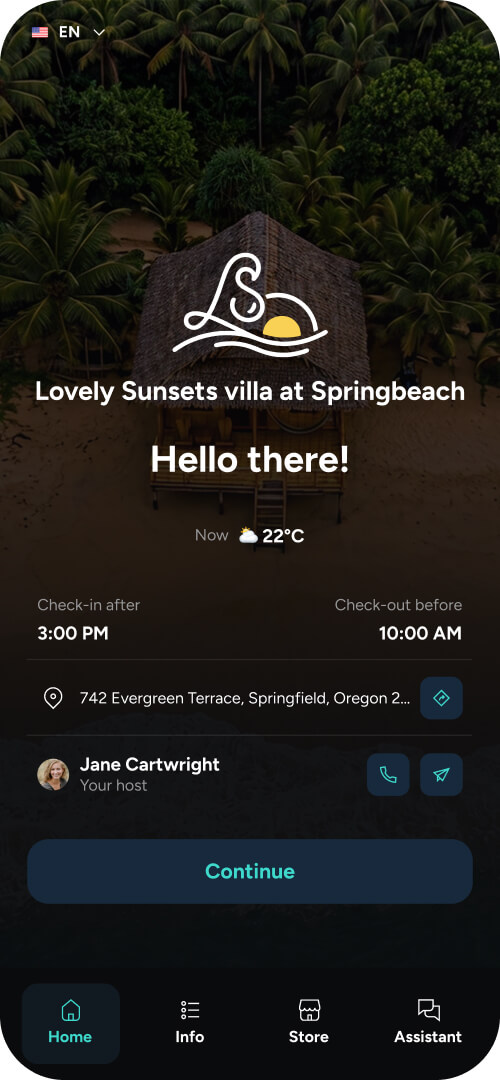
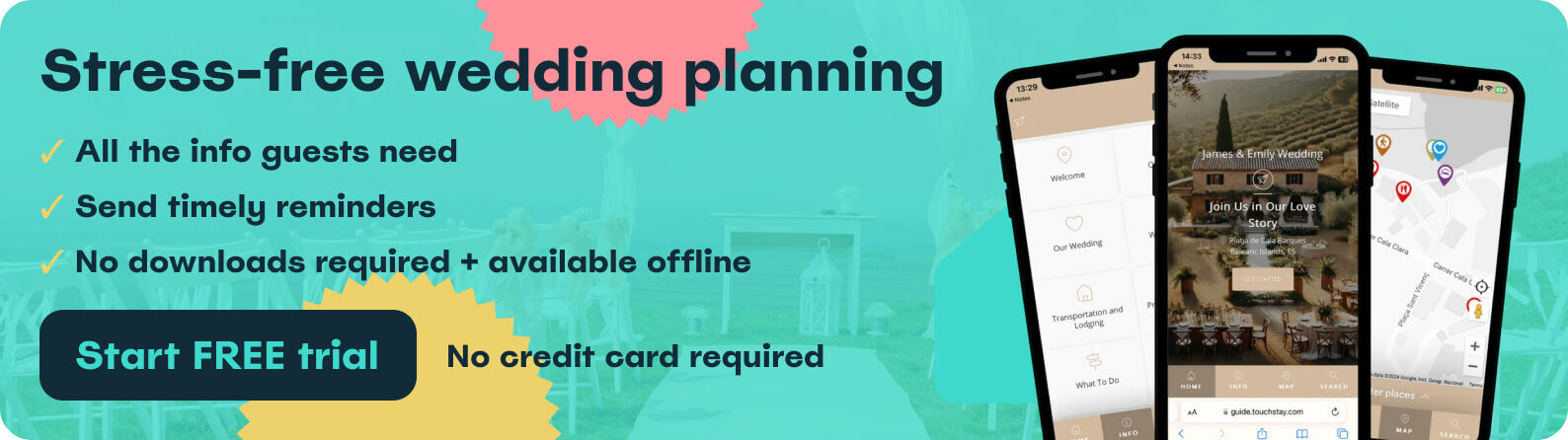
TouchStay is a practical home for this layer. You can keep check-in instructions, house rules, Wi-Fi details, appliance notes, and local recommendations in a branded digital guide guests can open without an app.
TouchStay can also connect guide content with scheduled email or SMS messages. If you use an AI chatbot trained on guidebook content, repeat questions can get answered faster while your team stays available for issues that need a person.
Make arrival instructions testable
Clear check-in instructions should read like a task someone can complete in the dark, tired, and carrying luggage. The goal is to remove guesswork before the guest reaches the door.
Have a second person test the instructions from a fresh device before the message goes out. This catches broken links, old screenshots, and codes that work only for the person who created them.
Include these items in your vacation rental welcome book checklist:
- A map pin that opens correctly
- Parking and unloading instructions
- Gate, elevator, or building access steps
- Smart-lock or lockbox instructions
- A backup access method
- Emergency contacts and support hours
If your property has poor cell service, say so before arrival. Give guests a downloadable guide or offline-friendly instructions so access doesn’t depend on signal strength at the door.
Property inspection checklist before guest arrival: clean, stocked, safe, and ready
The property inspection is the handoff between your marketing promise and the delivered stay. This is where your listing becomes a real home that guests can use.
Your vacation rental property inspection checklist before guest arrival should cover cleanliness, supplies, working systems, safety, and local rules. A vacation rental amenities checklist for guests belongs here too, because stocking decisions shape comfort from the first hour.
Use a room-by-room turnover standard
A room-by-room rental inspection checklist helps cleaners, inspectors, and managers judge the same stay by the same rules. It should include visible cleaning and the hidden spots that create complaints.
Airbnb’s host ground rules require cleaning between stays and say listings must be free of health hazards and extensive dust. They also call out pet dander, dirty dishes, and similar conditions.
Build checks for shower drains, sofa gaps, remote controls, switches, utensil drawers, and mattress protectors. These are small items until they appear in a review.
A manager or rotating auditor should inspect a sample of turnovers for larger homes or premium stays. If a defect can’t be fixed before arrival, tell the guest before they discover it.
Stock the basics before adding extras
Before you think about treats, decide what to stock in a vacation rental for a normal arrival. Airbnb identifies toilet paper, hand and body soap, and at least one towel as starting amenities for a prepared space.
Guests also expect clean bedding, working lighting, and internet that has been tested before arrival. If laundry, coffee, pool towels, or kids’ gear appear in the listing, stock them consistently.
A practical amenity essentials checklist could include:
- Paper goods and soap for the first night, with refill storage if promised
- One towel per booked guest at minimum, plus extras where pools or beaches are part of the stay
- Fresh bedding, mattress protectors, and pillows checked for age and stains
- Working bulbs, remote batteries, appliance cords, and climate controls
- Tested Wi-Fi, with the speed in Mbps published when remote work is a likely use case
Community feedback backs this up. In a thread on r/airbnb_hosts, hosts kept coming back to practical comfort items such as water pressure, blackout curtains, and enough seating as details guests remember in reviews.
Prioritize reliable amenities over novelty
More amenities don’t automatically create better stays. A feature that works every time can matter more than a flashy add-on that fails twice a season.
A 2025 amenities study found meaningful associations for office and entertainment amenities. Ambiance, safety, and accessibility features also showed associations. Broad kitchen and living-room categories were not significant in that model, and bedroom, bathroom, and outdoor categories landed in the same group Tourism and Hospitality Research.
That doesn’t mean kitchens or bathrooms are unimportant. Many basic amenities prevent dissatisfaction, while distinctive and reliable features may help a listing stand out.
Check safety, privacy, and local compliance before every stay
Safety checks should follow local requirements, not a generic internet list. Booking.com states that short-term rental partners remain responsible for complying with country, regional, and municipal rules, and properties can be closed on the platform for regulatory breaches Booking.com for Partners.
Keep a property file with license details, inspection dates, tax registration, insurance, and emergency contacts. Add building rules if the home sits in a condo, HOA, strata, or resort community.
Disclose permitted monitoring devices clearly
Guests should never have to wonder whether they’re being recorded inside the home. Keep surveillance disclosures short, direct, and visible before booking.
Vrbo says hosts may not use devices that capture video or audio inside the home. It also requires disclosure of permitted exterior monitoring.
If you use exterior cameras, noise monitors, or similar tools, state where they are and what they do. Check platform policy and local privacy law before installing or changing any device.
Vacation rental check-in checklist for guests: make the first ten minutes predictable
Check-in works when guests can find the property, get inside, and reach help if access fails. The first ten minutes shape the tone for the rest of the stay.
A vacation rental check-in checklist for guests should remove fragile steps. Codes, directions, lighting, and backup support all need testing before arrival.
Test the arrival path end to end
Walk the guest’s arrival path from the street to the first light switch. Test driving directions, parking access, exterior lighting, gate codes, lock operation, alarm steps, and interior lighting.
Do this after every code change, lock battery replacement, or parking-rule update. A working lock in the morning can still fail if the wrong code gets pasted into the message.
Place the unit number and access steps in text, not only in a photo. Guests may be using screen readers, translation tools, or a low-bandwidth connection.
Give self-check-in a human backup
Self-check-in still needs a support promise. Guests should know who is monitoring the phone, how fast urgent access issues get answered, and what backup method exists.
Airbnb’s host expectations include readily accessible listings, correct directions, and updated key codes throughout the stay Airbnb. Access is an ongoing host duty, not a one-time setup task.
If you can’t offer round-the-clock phone support, state the monitored hours and give emergency guidance. Lockouts during the check-in window should never rely only on an email inbox.
Keep the welcome moment short and useful
The welcome moment should focus on what the guest needs right after opening the door. Wi-Fi, thermostat basics, and emergency exit information are usually the first facts to surface.
Avoid asking guests to read a long manual before they can relax. A short message can point them to the digital guide while giving the highest-use details right away.
This is where a vacation rental welcome checklist helps. It keeps the first-hour information short while leaving deeper details in the guide for guests who need them later.
In-stay support checklist: respond quickly and recover well
Guests don’t expect every stay to be flawless. They do expect someone to take ownership when something goes wrong.
In-stay support should focus on live problem-solving. Automation can answer repeat questions, but access failures, leaks, safety concerns, and broken systems need a clear path to a person.
Set response standards by issue severity
A vague “we reply fast” promise isn’t enough. Set response standards based on the impact on the stay.
Lockouts, safety issues, and water-loss incidents need urgent acknowledgment. A practical target is within 10 minutes during the arrival window, with a phone call if the message isn’t seen.
Heating, cooling, Wi-Fi, and appliance failures need same-day ownership. Low-impact questions can wait longer, as long as guests know when to expect a reply.
Use automation as the first door, then escalate cleanly
Saved replies, digital guides, QR codes, and PMS inboxes can reduce friction. They work best when they point guests to the right answer quickly.
Automation should never trap a guest in a loop. If the issue affects access, safety, sleep, or basic comfort, the system should move the guest to a monitored channel.
Personalize the first sentence of any saved reply. A guest who reports a broken shower doesn’t want a generic paragraph about house rules.
Document service recovery decisions
Service recovery needs a repeatable pattern. Without one, your team may overreact to minor issues and underreact to stay-defining problems.
Use this pattern when a guest reports a problem:
- Acknowledge the impact on the stay.
- Ask only for the facts needed to act.
- Give the next action and a time.
- Follow up after the fix.
- Record the remedy, cost, vendor, and guest response.
Pre-approve remedies where you can. Replacement supplies, technician dispatch, late checkout when feasible, or a partial refund path can all speed up decisions.
Vacation rental checkout checklist for hosts: end the stay without adding friction
Checkout should create a clean handoff to operations. It shouldn’t make guests feel like they’ve been assigned a shift on the housekeeping team.
A vacation rental checkout checklist for hosts works best when guest tasks stay short and fair. The heavier work belongs to your staff process after departure.
Ask only for reasonable checkout tasks
Send a short reminder the day before departure. A lighter same-day note can help if the property has a strict checkout time or gate process.
Airbnb’s 2026 checkout guidance says hosts can place checkout instructions in the arrival guide. It also warns that repeated low ratings for excessive checkout tasks can put a listing at risk.
Reasonable tasks include locking up, returning keys, turning off specified equipment, and placing trash in the designated spot. Guests in a Reddit thread about long checkout instructions mostly pushed back on time-consuming departure chores, especially when a cleaning fee was involved.
Turn departure into a clean staff handoff
Once guests leave, housekeeping should inspect quickly and record any issue with timestamps. Lost property needs a secure place and a clear contact process.
Reset codes before the next stay. Trigger maintenance right away if a defect could affect the next guest.
This handoff should be host-side work. If guests leave the home reasonably tidy, your system should handle the rest.
Ask for reviews after unresolved issues are closed
Review requests work best after the guest has had a chance to report problems. If an issue is still open, close the loop before asking for public feedback.
Airbnb gives both parties 14 days after checkout to submit reviews. Reviews publish once both have submitted or when the period ends.
Ask for an honest review, not a positive one. Mention that feedback on accuracy, cleanliness, access, and communication helps you improve future stays.
Post-stay improvement checklist: measure guest satisfaction and repeat-booking potential
Reviews are a feedback system, not only a reputation asset. Read them as operating data, especially when the same theme appears across properties or seasons.
A vacation rental guest satisfaction checklist should track problems before reviews make the pattern public. That means measuring response, resolution, check-in reliability, cleanliness, and repeat-booking signals.
Track leading indicators before reviews expose the pattern
Positive reviews and consistent communication are trust drivers in Expedia’s 2025 traveler research. Don’t wait for the monthly rating average to tell you where the operation is slipping.
Track leading indicators by property, channel, cleaner, and season. A single average can hide a recurring lock issue at one cabin or a Wi-Fi problem that affects remote workers.
Use these five measures:
- Listing-accuracy defects found before arrival
- First-response time by issue severity
- Resolution time for stay-impacting problems
- Check-in failures per 100 stays
- Cleanliness or maintenance complaints per stay
Review these metrics weekly if you manage multiple homes. A single-home host can still use the same list after every stay.
Read reviews by theme instead of rating alone
Star ratings can be useful, but they don’t tell you what to fix. A 4-star review with a complaint about parking may matter more than a 5-star review that says only “great stay.”
Group review comments into themes such as access, sleep quality, Wi-Fi, temperature, cleanliness, and communication. Then compare those themes with support messages and maintenance logs.
If parking confusion appears in three messages and one review, rewrite the arrival instructions. If temperature complaints spike in summer, test the HVAC before the next heat wave.
Use the 80/20 rule as a prioritization lens
The 80/20 rule for Airbnb guest experience means a small number of repeated failures may cause a large share of frustration. It’s a way to decide what to fix first.
Look for repeat patterns. A lock that fails twice in 20 stays deserves faster action than a one-off request for a different pillow style.
Use the rule to fund operational fixes. Replace the recurring lock problem, rewrite the confusing parking message, or add blackout curtains where sleep complaints keep appearing.
Clarify the 75/55 question without letting it derail the article
The “75/55 rule” isn’t an official Airbnb guest-experience requirement. Host content uses the label inconsistently, including as an investment-screening benchmark and as a pricing-discipline framework.
Treat it as outside this checklist. Guest experience should be measured through accuracy, access, cleanliness, communication, service recovery, reviews, and repeat stays.
Turn satisfied guests into permission based repeat booking opportunities
Repeat bookings depend on a reliable stay and a compliant way to stay in touch. Don’t collect more guest data than you need, and respect platform rules for platform-originated bookings.
When guests permit follow-up, send useful messages rather than constant promotions. Seasonal local tips, a repeat-guest rate, or early access to preferred dates can feel relevant when the stay itself was strong.
Turn the checklist into a three layer guest experience system
A complete checklist needs different views for guests, staff, and management. Each layer should hold the right amount of detail for the person using it.
Guests need clear answers. Staff need task ownership. Managers need performance signals that show whether the system is getting stronger.
The guest facing layer
The guest-facing layer includes the listing, arrival guide, house rules, emergency card, and checkout message. This is the information guests see before and during the stay.
TouchStay fits naturally here when you want one mobile-friendly guide instead of scattered messages. Guests can open the guide before arrival, find answers during the stay, and use the same source for checkout details.
Keep this layer concise. The guide can hold depth, but the messages should point guests to what they need at that moment.
The staff facing layer
The staff-facing layer covers room-by-room turnover, safety checks, access testing, inventory records, and maintenance logs. This is where the operating promise gets signed off before the guest arrives.
Ownership matters more than document length. Every handoff should have a named person, a completion time, and a way to record defects.
A cleaner may sign off on linens and bathrooms. A manager may sign off on access, safety, and any guest-facing disclosure before arrival.
The management layer
The management layer turns the checklist into a dashboard. It should track accuracy, response times, cleanliness, incidents, review themes, and repeat bookings.
Standardization protects the guest experience while leaving room for local warmth. You can have the same inspection gates across every home and still recommend the best bakery near one cottage or the rainy-day museum near another.
A simple policy block can look like this:
Guest-facing owner: Updates listing, guide, house rules, emergency card, and checkout message before each season.
Staff-facing owner: Signs off turnover, supplies, safety, access, and maintenance before release.
Management owner: Reviews accuracy defects, response times, guest complaints, review themes, and repeat-booking data every month.
Escalation rule: Any issue affecting access, safety, sleep, cleanliness, or core amenities gets documented and reviewed before the next stay.
That structure keeps the checklist from becoming a forgotten document. It turns guest experience into a working system.
Conclusion
Great vacation rental guest experience comes from doing predictable things consistently, then adding local personality once the basics are stable. The best checklist prevents avoidable uncertainty before guests have to ask for help: the listing is accurate, access works, the home is ready, support responds, and checkout is fair.
When you split the work into guest-facing, staff-facing, and management layers, each person knows what they own. If you want to turn the guest-facing layer into one easy digital guide, TouchStay is a practical next step for keeping arrival details, house rules, Wi-Fi, local tips, and checkout instructions in one place guests can use before and during the stay.
Touch Stay
Be the first to know!
Join our newsletter for early access to:
- ✅ Free guides
- ✅ Pro tips & tricks
- ✅ Time saving tutorials
- ✅ Latest blog posts
- ✅ Checklists & templates
Thanks for subscribing! You're on the list.