
.png?width=50)
Summarize in
TL;DR (Quick Answer)
How do you improve the guest journey before, during and after a stay?
Fix the handoffs at booking, pre-arrival, check-in, in-stay service and post-stay follow-up. Clearer promises, fewer gaps between systems, faster recovery, and one mobile-first source of truth for guests. TouchStay centralizes the information and messaging across all five stages.
Key Takeaways
- Five stages: discovery and booking, pre-arrival, arrival and check-in, in-stay, checkout and post-stay.
- Clarity, choice and continuity are the three filters for spotting friction in any guest-facing process.
- Booking content has to match across website, OTAs, booking engine and confirmation message.
- Arrival is where guests get stuck most. Check-in is the second-biggest chatbot topic in Touch Stay data at 3,822 questions.
- Every in-stay request needs an owner, a timestamp and an escalation path.
- Post-stay works best when private feedback comes first and public reviews come after issues are handled.
In this article, we'll cover:
- Map the five stages of the hotel guest journey
- Stage 1: discovery and booking
- Stage 2: pre-arrival
- Stage 3: arrival and check-in
- Stage 4: during the stay
- Stage 5: checkout and post-stay
- Connect the touchpoints with the right technology
- A before-during-after checklist
- Measure whether the guest journey is actually improving
- Conclusion
Map the five stages of the hotel guest journey
The guest experience begins with expectation-setting
It starts with what a traveler believes they're buying, and that belief forms in search results, OTA pages, social content, reviews and your own website. Long before anyone touches a front desk.
The five stages at a glance
Discovery and booking, pre-arrival, arrival and check-in, in-stay, checkout and post-stay.
The journey works when each stage passes accurate information to the next. A preference captured at booking should be visible before arrival, honored at check-in, and remembered after checkout. Most properties lose it somewhere in the middle.
The three Cs: clarity, choice and continuity
Use them as a test for any guest-facing process. If a step creates confusion, removes control, or drops information between teams, it needs work.
- Clarity removes uncertainty about policies, timing, directions, charges and what's included.
- Choice gives guests control over routine tasks: check-in style, communication channel, checkout method.
- Continuity keeps each promise visible to whoever has to deliver it next.
Stage 1: discovery and booking, set expectations you can deliver
Booking creates work for operations long before anyone arrives. When marketing promises one thing and the property delivers another, staff inherit a service problem they didn't create.
Align your website, OTAs and booking engine
Room photos should match the actual room type, policies should be findable, required charges should appear before payment.
Then compare the booking engine, OTA listings and confirmation message. They need to tell the same story about room attributes, parking, breakfast, deposits, cancellation terms and check-in times. Book through one channel, get a different promise by email, and trust drops before arrival.
Use the four Ps to check the booking promise
Product is the room, amenities, service level and access. Price is value and what's included. Place is location claims, arrival instructions and how easy the property is to reach. Promotion is how offers, photos and copy frame the stay.
Applied narrowly, they answer one useful question: can the operation deliver what the booking journey sells? A "quiet work-friendly room" means nothing if room assignment can't keep that guest away from the elevator.
Capture useful preferences with consent
Keep preference capture short and actionable. Arrival time, dietary needs, accessibility requirements, a crib, a celebration. Things a team can route.
Deloitte's 2025 travel outlook argues trip type and individual history produce more relevant recommendations than broad age or income segments. A business traveler wants a quiet room and early breakfast. A family arriving late wants parking and bedding. That's the level of personalization worth building.
Make direct booking feel easier, not riskier
Direct benefits work when they reduce doubt. Richer room choice, clearer flexibility, direct access to the team handling requests. All more persuasive than a vague best-price claim.
Show the policies plainly. If direct guests can pick room attributes, add arrival notes or change dates more easily, say so in practical terms.
Stage 2: pre-arrival, turn the reservation into confidence
Send fewer, better-timed messages
Confirmation right after booking, a logistics note a few days out, a readiness message close to check-in. Three is usually enough.
Oracle's global survey found 73% of travelers more likely to choose a hotel offering self-service technology. That's an argument for better self-service, not more outbound messages.
Personalize with a short, actionable survey
Two to five questions, sent two to five days before arrival, giving staff time to act on allergies, bedding, late arrival or a crib.
Every question needs an owner, a place in the guest profile, and a service action attached. If nobody can act on the answer, don't ask it.
Offer extras when they solve a real need
Hotel upsell ideas should read as convenience. And the Touch Stay store data is clear about what guests actually buy: across 385 orders, Late Check-out ranks first (37 orders) and Early Check-in third (18), with booking access the largest category overall at 97 orders.
Time flexibility outsells everything else. Before you build a welcome-hamper programme, make sure early check-in and late checkout are bookable in two taps.
Avoid broad discount blasts. They train guests to ignore messages that might otherwise help them.
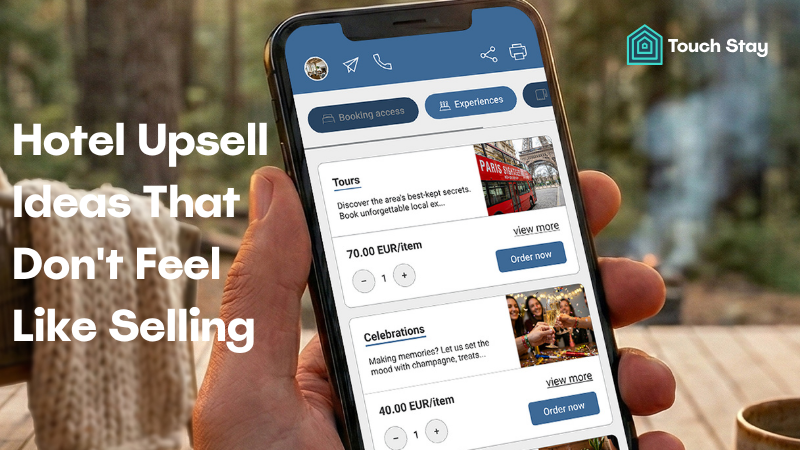
Give guests one mobile-first source of stay information
Guests shouldn't be searching across emails, PDFs and lobby signs for basic facts. A digital hotel compendium holds them in one place. In Touch Stay data, Arrival Information is the most-opened guidebook category at 209,000 unique views, with Welcome at 203,000 and WiFi / Internet Details at 106,000. That's what pre-arrival demand actually looks like.
A well-designed guest experience brings all of these touchpoints together, giving guests the right information and support at the right time.
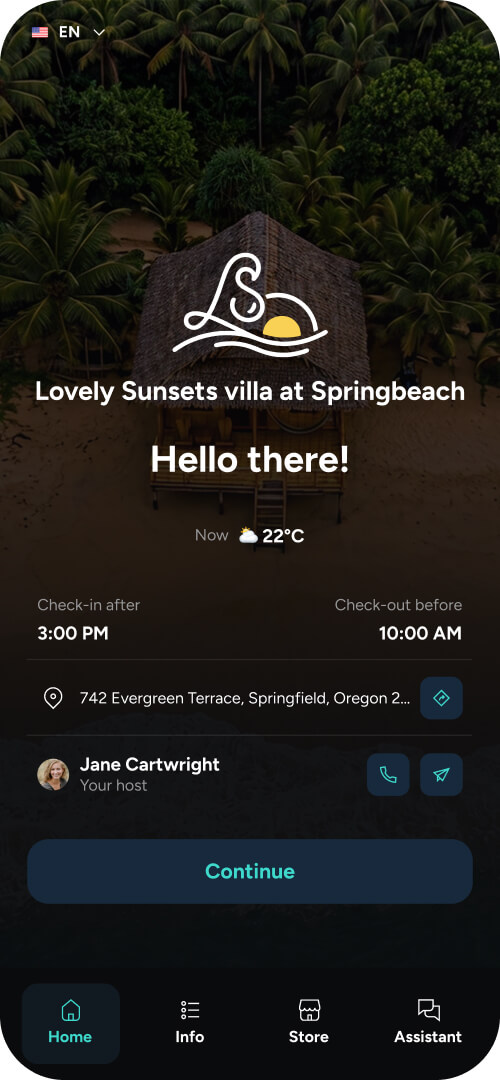
TouchStay guidebooks hold check-in instructions, house rules, Wi-Fi details and local recommendations, shared by link, QR code or automated messaging, with no app download.
Stage 3: arrival and check-in, prove the promise fast
Arrival is the first live proof you can deliver what you sold.
Match self-service and human welcome to the stay type
Digital check-in should be an option rather than a replacement. J.D. Power's 2025 Japan study found automated check-in linked to stronger satisfaction in economy hotels, while face-to-face performed better in full-service categories.
Which tracks operationally. A time-pressed guest wants a kiosk or a mobile key. A guest at a resort expects warmth and someone who can answer questions.
Keep room status, ID, payment and keys in sync
A smoother check-in flow depends on behind-the-scenes discipline. Housekeeping status has to update quickly, payment authorization has to work, and key access has to match the assigned room. A contactless flow captures identity first, then payment authorization, room assignment and mobile-key issuance. It only feels easy when every system updates reliably.
This is where guests get stuck most often. Check-in is the second-largest chatbot topic in the Touch Stay network at 3,822 questions, behind only location and directions, and Access Codes / Instructions draws 55,100 unique topic views. The negative conversations get specific: the lockbox won't open, the fob doesn't work, nobody's answering.
Treat the first room inspection as a recovery checkpoint
The first few minutes after the door opens are a recovery window. Guests notice cleanliness, temperature, Wi-Fi, whether the key worked, whether the promised amenities are actually there.
Give them a fast way to report a problem. If the only feedback moment is checkout, they've already carried it through the whole stay.
Stage 4: during the stay, improve the experience while recovery is still possible
Post-stay apologies can't fix a bad night's sleep.
Protect the fundamentals guests feel in the room
Cleanliness and sleep quality first. Then Wi-Fi, bathroom condition, and anything that should work without a call to the desk.
Expectations around in-room technology are rising. A recent industry study found 40% of guests calling smart-TV streaming a need-to-have, up from 21% in 2019, and tied satisfaction gains to furnishings, bathroom fixtures and bed comfort.
Wi-Fi remains the loudest problem. In Touch Stay chatbot data it's asked word-for-word 247 times, plus another 119 for "WiFi password", and "WiFi not working" is the single most common trigger for a negative conversation. No hot water is second.
Route every request to an owner
A guest-service channel should create accountable work rather than more inbox noise. SMS, WhatsApp, app message, QR code or front desk, every request needs an owner and a timestamp.
Set an escalation path for anything sitting too long. A towel request shouldn't depend on who happens to open a shared inbox first.
Staff your response windows against real demand, too. Touch Stay guest activity peaks between 14:00 and 22:00 UTC and bottoms out between 04:00 and 07:00, which argues for response targets set by hour rather than one flat SLA that's soft at 6pm and impossible at 5am.
Use a first-night pulse check
One short message after the first night catches noise, temperature, room condition or a dining problem while you can still fix it. Keep it light and skippable for guests who prefer less contact.
The case for it is in the numbers: J.D. Power found only 12% of stays involved a reported problem, but those problems dropped satisfaction 217 points (J.D. Power).
Give staff room to recover gracefully
Staff need authority, context and documentation. A service playbook should say who can apologize, relocate a guest, replace an item, approve a comp, and what follow-up looks like.
AI can triage routine questions and summarize context. Anything emotional or unusual should reach a person fast.
Stage 5: checkout and post-stay, close the loop and earn the next visit
Make checkout quick unless a conversation is needed
Routine departures should be fast: accurate folio, clear receipt delivery, help with luggage or transport, deposit release timing stated plainly.
Digital checkout suits guests with nothing outstanding. A human conversation still matters after a complaint, or where someone can save the relationship before the guest leaves.
Ask for private feedback before public praise
Send the receipt immediately, ask for private feedback within 24 to 48 hours, and request a public review only after you've had a chance to address anything raised privately.
TouchStay's 5-Star Feedback runs that sequence automatically. A pop-up fires at a moment you choose, 24 hours before checkout or once a guest has been using the guidebook, and the rating decides what happens next: high scores go to your Google listing, anything lower opens a private form that reaches your dashboard instead of the internet.
Turn post-stay data into operations and loyalty
Feedback should feed maintenance, housekeeping, billing and guest profiles. If three guests mention low shower pressure in the same room, that belongs in an operations queue, not just a reputation report.
A resolved issue becomes a reason to return when the follow-up is specific and the next stay reflects what was learned.
Connect the hotel guest journey touchpoints with the right technology
Technology should support the five stages, not take over the relationship.
PMS and CRM: the operational memory
The PMS stays the system of record for reservations and room inventory, and holds profiles, rates, folios and stay events. Everything else should read from it rather than keeping a second version of the truth.
Guest messaging, guidebooks and self-service tools: the communication layer
Hotel experience tools cut repeated questions when they draw on accurate property information, and let guests solve routine needs without queueing.
TouchStay offers digital guidebooks, an AI chatbot, an upsell widget, contact collection, two-way messaging and PMS integrations that share guidebooks automatically. It works alongside existing systems or on its own, which suits properties that want better hotel communication before a full tech refresh.
Feedback and reputation tools: the listening layer
Surveys and reviews need to connect to property-level action. If a theme keeps appearing, the right department has to see it, own it and report back on the fix.
AI and automation: the guardrails
Automation suits routine questions, context summaries and routing. It shouldn't make promises the property can't keep.
The risks are practical: wrong answers, privacy exposure, failed escalation. A guest asking about a billing dispute, a room move or a safety concern needs a person quickly.
|
Technology layer |
Main job |
Touchpoints it supports |
What to watch |
|---|---|---|---|
|
PMS and CRM |
Hold reservation, profile, room and folio data |
Booking, arrival, in-stay, checkout |
Duplicate profiles, stale preferences |
|
Messaging and guidebooks |
Give guests answers and a direct route to staff |
Pre-arrival, arrival, in-stay |
Outdated property details, unowned requests |
|
Self-service tools |
Let guests complete routine tasks faster |
Check-in, keys, checkout |
Mobile-key failure, weak staffed fallback |
|
Feedback and reputation |
Turn comments into themes and tasks |
In-stay, post-stay |
Reports that never reach operations |
|
AI assistance |
Answer simple questions, summarize context |
Pre-arrival, in-stay, post-stay |
Wrong answers, privacy gaps, poor escalation |
A before-during-after checklist for improving the hotel guest experience
A quick audit. It won't replace deeper mapping, but it shows where guests are likely to feel friction.
Before the stay
- Match your booking engine to OTA content, then check the confirmation message against both.
- Show required charges and policy deadlines before payment.
- Capture only preferences a team can act on.
- Give guests one mobile-first place for check-in details, Wi-Fi, parking and local information.
- Route pre-arrival requests to whoever owns the task.
During the stay
- Confirm room readiness before assigning the room.
- Make the service channel visible in the room and in digital stay information.
- Give every request an owner, a timestamp and an escalation point.
- Send one light first-night pulse check where it fits the stay type.
- Give staff clear authority to apologize, replace, relocate or follow up.
After the stay
- Send the receipt immediately and make billing questions easy to raise.
- Ask for private feedback within 24 to 48 hours.
- Respond to complaints with specific recovery steps.
- Request public reviews from satisfied guests once private concerns are handled.
- Turn recurring themes into maintenance, housekeeping, training or profile updates.
Measure whether the guest journey is actually improving
Without measurement, teams mistake more messages and more tools for progress.
Experience and reputation signals
Track overall satisfaction and room scores, then cleanliness, staff helpfulness, review volume and review response time as recurring guest satisfaction signals.
NPS shows direction; diagnostic questions explain what to fix. Review themes matter too, since a handful of repeated comments can surface a property issue before the scores move.
Operational signals
Check-in time, mobile-key failure rate, message first-response time, request resolution time, room-ready accuracy.
Add one more that most properties never track: the share of guest questions you can't answer. In the Touch Stay network, 15.2% of chatbot conversations return no answer because the information isn't in the guidebook. One in six. It costs nothing to measure and it names its own fix.
Segment everything by property, shift, room type and trip purpose. An average hides the recurring problem, like slow evening check-in for late flight arrivals.
Commercial and loyalty signals
Direct-booking share, upgrade conversion, ancillary revenue, repeat booking rate.
Cohort analysis gives the clearest view. Compare repeat bookings from guests whose issue was resolved quickly against guests whose issue stayed open. If fast recovery drives return behaviour, you have your case for better staffing, routing and tools.
Conclusion
Better guest journeys come from clearer promises, easier self-service, faster recovery and more useful follow-up. Technology makes the property easier to understand and easier to reach. Staff create the warmth and judgment guests actually remember.
Start with the handoffs between booking, pre-arrival, check-in, in-stay service and post-stay feedback, then measure whether guests are hitting less friction. If you want a branded, mobile-first guide for before and during the stay, TouchStay centralizes guest information and messaging.
The handoffs from pre-arrival to post-stay only improve when guests and staff work from current information. Touch Stay's Digital Guidebook gives hotels one mobile-first source for the practical details, while Guest Messaging sends it at the right moment. Touch Stay says 92% of users report fewer guest questions after sharing a digital guidebook.
Connect the journey with one guide guests actually use.