
.png?width=50)
Summarize in
There's a moment in every host's journey where "it'll be fine" stops being a strategy. Maybe it was a party you found out about from the neighbors. Maybe it was a guest who "just needed to stay two more nights" and wouldn't leave. Maybe it was a damaged sofa and a guest who insisted it "was already like that."
That's the moment a rental agreement stops feeling like paperwork and starts feeling like a seatbelt.
Airbnb's platform terms cover the basics, but they don't spell out your rules, such as your quiet hours, your guest cap, your pet policy, and your damage terms, in a document the guest has actually agreed to. A short-term rental agreement does. It's the difference between hoping a guest respects your rules and having them acknowledge, in writing, that they will.
In this guide we'll cover:
-
What an Airbnb rental agreement is (and why the platform terms aren't enough
- Make the agreement a living document, not a one-time signature
- Frequently asked questions
A quick, important note:
Touch Stay is a guest-experience company, not a law firm, and nothing here is legal advice. Short-term rental laws vary enormously by country, state, and even city, and so do the rules about what you can enforce. Use this template as a starting point and have a qualified local attorney review your final agreement before you rely on it. Consider that disclaimer repeated everywhere below.
What an Airbnb rental agreement is (and why the platform terms aren't enough)
An Airbnb rental agreement, also called a short-term rental agreement or vacation rental contract, is a document between you (the host) and your guest that spells out the terms of their stay: the rules, the responsibilities, the money, and what happens when something goes wrong.
You might reasonably ask: Airbnb already has terms of service and a booking process, so why do I need my own?
Because the platform's terms are general. They govern the relationship between users and Airbnb. They don't say that your property allows a maximum of six guests, prohibits pets, charges for late check-out, and holds the guest responsible for damage beyond normal wear.
A rental agreement makes your specific expectations explicit and gets the guest to agree to them before they arrive. If a dispute ever escalates, whether to Airbnb's Resolution Center, to a chargeback, or beyond, a signed agreement is evidence that the guest knew and accepted the rules.
For hosts operating at any real scale, especially property managers with multiple listings, it's less "nice to have" and more standard operating procedure.
When you should (and shouldn't) use a rental agreement
A rental agreement makes the most sense when:
- Your bookings are higher-value or longer. The more money and the more nights involved, the more you want written terms.
- Your property is higher-risk. A large home that sleeps twelve, a place with a pool or hot tub, a listing in a party-prone city: these carry risks worth documenting.
- You allow anything conditional. Pets on approval, events on approval, early check-in for a fee: conditional policies need written terms to be enforceable.
- You manage multiple properties. Property managers should standardize a single agreement across the portfolio so nothing falls through the cracks.
- Local law requires it. Some jurisdictions require a written rental agreement or specific disclosures for short-term rentals. Check yours.
When might you keep it lighter? For a single spare room, a one-night stay, or a very low-value booking, a full contract can create more friction than it's worth, though even then, a clear set of house rules in your guidebook is wise. The judgment call is yours; when in doubt, having the agreement and not needing it beats needing it and not having it.
The clauses that actually protect you
A rental agreement is only as good as its clauses. Here are the ones that do real work, the sections worth getting right rather than copying blindly.
Parties and property. Who's renting, who's hosting, and exactly which property. Include the guest's full legal name and the property address. This anchors the entire agreement.
Dates and occupancy. Check-in and check-out dates and times, and the maximum number of guests. The occupancy cap is one of the most-violated rules in short-term rentals, so state it plainly and note that unregistered guests or exceeding the cap is a breach.
Payment, fees, and deposits. The total amount, what's included, and any additional fees: cleaning, pet fee, late check-out. If you take a security deposit or use Airbnb's damage-protection framework, describe it. Be precise about refundability.
House rules. No smoking, quiet hours, no parties or events, pet policy, shoes-off, whatever your non-negotiables are. You can reference your full house rules and incorporate them by attaching them. (Your house manual is the natural home for the detailed version.)
Damage and liability. State that the guest is responsible for damage beyond normal wear and tear, and that they'll report damage promptly. Include a liability clause noting guests use amenities (pool, hot tub, grill, stairs) at their own risk, and have a lawyer make sure it's enforceable where you operate.
Cancellation and refunds. Reference your Airbnb cancellation policy so there's no daylight between the platform and your contract.
No unauthorized parties or events. Given how much damage a single unsanctioned party can do, many hosts give this its own clause with clear consequences.
Cleaning and check-out expectations. What you expect on departure and any fees for excessive mess. Point to your check-out instructions for specifics.
Governing law. Which jurisdiction's law applies. This is exactly the kind of clause where local legal advice matters.
Acknowledgment and signature. A line confirming the guest has read and agrees, with a signature and date (electronic is fine in most places).
A complete Airbnb rental agreement template
Below is a full template you can copy and adapt. Fill in every bracket, delete what doesn't apply, and, one more time, have a local attorney review it before use. This is a starting framework, not a finished legal document, and it isn't legal advice.
SHORT-TERM RENTAL AGREEMENT
This Short-Term Rental Agreement ("Agreement") is entered into between [Host Full Name / Business Name] ("Host") and [Guest Full Name] ("Guest") for the short-term rental of the property described below.
1. Property The property located at [Full Property Address] (the "Property").
2. Rental Period Check-in: [Date] at [Time] Check-out: [Date] at [Time] The Guest agrees to vacate the Property by the check-out time. Late departure without prior written approval may incur a fee of [$Amount] and/or charges equal to an additional night.
3. Occupancy The maximum number of overnight guests is [Number]. Only registered guests may stay overnight. Exceeding the stated occupancy or hosting unregistered guests is a material breach of this Agreement and may result in additional charges or termination of the stay without refund.
4. Payment and Fees Total rental amount: [$Amount], payable through Airbnb per the booking. Additional fees: cleaning fee [$Amount]; pet fee (if applicable) [$Amount]; other [describe]. All fees are as displayed at booking.
5. Security Deposit / Damage A security deposit of [$Amount] [or: damage protection as provided through Airbnb] applies. The Guest is responsible for the cost of any damage to the Property or its contents beyond normal wear and tear, and agrees to report any damage or malfunction to the Host promptly.
6. House Rules The Guest agrees to abide by the following, incorporated as part of this Agreement:
- No smoking or vaping inside the Property.
- No parties, events, or gatherings beyond registered guests without the Host's prior written consent.
- Quiet hours are observed between [Time] and [Time].
- Pets are [not permitted / permitted only with prior written approval and applicable fee].
- [Add any additional rules: pool/hot tub use, parking, shoes-off, etc.] Full house rules are provided in the Property guidebook and form part of this Agreement.
7. Liability The Guest and their invitees use the Property and all amenities, including but not limited to [pool, hot tub, grill, stairs, balcony], at their own risk. To the fullest extent permitted by law, the Host is not liable for injury, loss, or damage to persons or property arising from use of the Property, except where caused by the Host's gross negligence.
8. Cancellation Cancellations and refunds are governed by the Host's cancellation policy as stated on the Airbnb listing.
9. Termination The Host may terminate this Agreement and require the Guest to vacate, without refund, for material breach, including unauthorized occupancy, unauthorized parties, illegal activity, or conduct that endangers the Property or others.
10. Governing Law This Agreement is governed by the laws of [Jurisdiction].
11. Acknowledgment By signing below, the Guest confirms they have read, understood, and agree to the terms of this Agreement and the Property's house rules.
Guest signature: __________________________ Date: ____________ Host signature: __________________________ Date: ____________
How to get guests to actually sign it (without friction)
A rental agreement only protects you if the guest agrees to it, and if you handle it clumsily, it can feel like being handed a contract at a friend's dinner party. A few ways to keep it smooth:
Send it before arrival, not at the door. Present the agreement as part of your pre-arrival flow, alongside check-in details, so the guest reviews it calmly rather than on the doorstep with luggage in hand.
Frame it as normal and mutual. "Here's our standard rental agreement so we're both on the same page about the stay" reads very differently from "Sign this or you can't come in." Most guests expect it and won't blink.
Use an e-signature. A simple electronic signature tool (or an acknowledgment step built into your guest onboarding) is far less friction than printing and scanning. In most jurisdictions, electronic signatures are valid, so confirm for yours.
Keep the rules visible after signing. Signing once and never seeing the rules again is how "I forgot quiet hours were a thing" happens. Which brings us to the part hosts most often miss.
Make the agreement a living document, not a one-time signature
Here's the gap in how most hosts use a rental agreement: the guest signs it once, days before arrival, and never looks at it again. The occupancy cap, the quiet hours, the pool rules all disappear into an email thread the moment they're inside your home.
The agreement protects you legally. But protection is cheaper than enforcement. What actually prevents the party, the extra guests, and the 2 a.m. hot-tub noise is a guest who remembers the rules while they're staying, and that only happens if the rules stay in front of them.
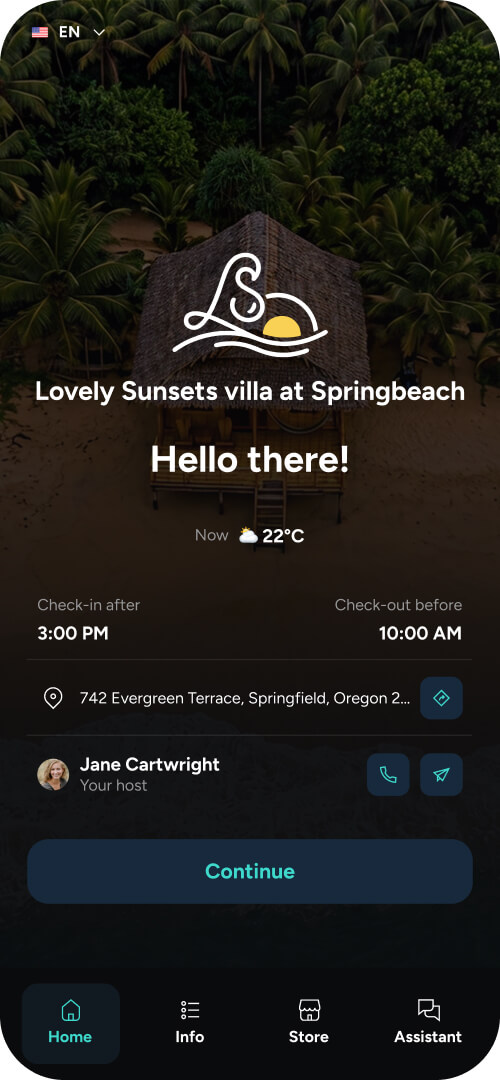
That's why the smartest setup pairs the signed agreement with a digital guidebook the guest can open any time during the stay. The agreement establishes what was agreed; the guidebook keeps the house rules, quiet hours, and amenity guidelines one tap away on the guest's phone throughout their visit. When your quiet hours or pet policy change, you update the guidebook once and every guest sees the current version, with no re-sending and no stale printout contradicting your contract.
The contract is the seatbelt. The living guidebook is what keeps guests driving carefully the whole trip. Touch Stay lets you build that branded digital guidebook so your house rules and check-out expectations live somewhere guests actually return to. Start with our complete Airbnb guidebook guide, then the Airbnb welcome book and house manual walkthroughs to set it up, and pair the agreement with a warm welcome letter and clear check-out instructions so nothing about the stay is left to memory.
Want your house rules living somewhere guests actually see them? Start a free Touch Stay trial and give the terms in your agreement a home guests can open any time.
Frequently asked questions
Airbnb's platform terms don't replace a rental agreement tailored to your property. A separate agreement lets you spell out your specific rules (occupancy, pets, parties, damage terms) and gets the guest to acknowledge them in writing. It's especially advisable for higher-value stays, higher-risk properties, and anyone managing multiple listings. This isn't legal advice; check your local requirements.
A properly drafted agreement that both parties sign is generally binding, but enforceability depends on your local laws and how the agreement is written. That's why a qualified local attorney should review your final version before you rely on it.
In most jurisdictions, electronic signatures are legally valid and far less friction than printing and scanning. Confirm the rules where your property is located, and consider building an acknowledgment step into your pre-arrival guest flow.
House rules are the specific behavioral expectations for your property (no smoking, quiet hours, and so on). A rental agreement is the broader contract that can incorporate those house rules along with payment, occupancy, liability, cancellation, and signature terms. The agreement gives the rules legal weight.
Keep them visible during the stay, not just at signing. A digital guidebook lets guests re-open the house rules and check-out expectations any time on their phone, which does far more to prevent problems than a signature the guest forgets about the moment they arrive.
This article is for general information only and is not legal advice. Short-term rental laws vary by location. Consult a qualified attorney in your jurisdiction before using any rental agreement.
Touch Stay


Be the first to know!
Join our newsletter for early access to:
- ✅ Free guides
- ✅ Pro tips & tricks
- ✅ Time saving tutorials
- ✅ Latest blog posts
- ✅ Checklists & templates
Thanks for subscribing! You're on the list.