

Summarize in
The hotel industry is not one market. It is dozens of distinct property types, each serving a different guest, competing on different terms, and succeeding by different rules. Understanding where you sit in that landscape, and where you deliberately do not, is one of the most useful strategic exercises a hotel operator can do.
This guide maps the main types of hotels, from the global chains to the independent boutique, and explains what each one is, who it serves, and how it competes.
In this article, we'll cover:
- Why the type of hotel matters
- Classifying hotels
- Types of hotels by size and structure
- Types of hotels by service level
- Types of hotels by purpose and guest
- What is a boutique hotel?
- How boutique hotels compete with the chains
- Where independents win: the guest experience
- Frequently asked questions
Why the type of hotel matters
The type of hotel a property is shapes almost everything about how it operates: who it markets to, what it charges, what guests expect, and where it can realistically compete.
For independent and boutique operators in particular, understanding the landscape is a competitive necessity rather than an academic exercise. A boutique hotel that tries to out-scale a chain will lose. A boutique hotel that understands exactly what the chains cannot do, and builds its entire proposition around that gap, can thrive in a market the giants cannot serve.
The sections that follow classify hotels along the axes that actually matter, then focus in on the boutique category and what it takes to win there.
Classifying hotels
There is no single official taxonomy of hotel types. Instead, hotels are usefully classified along three overlapping axes, and most properties can be described by their position on each.
By size and structure, from a handful of rooms in an independent property to thousands across a global brand. By service level, from budget and limited-service to full-service luxury. And by purpose and guest, from business hotels near convention centers to resorts built for leisure and destination stays.
A single property sits somewhere on all three axes at once. A boutique hotel, for example, is typically small in size, mid-to-high in service level, and leisure-or-experience-oriented in purpose. Reading a property across all three axes gives a much clearer picture than any single label. The sections below take each axis in turn.
Types of hotels by size and structure
Size and ownership structure shape a hotel's economics and its guest experience more than almost anything else.
Chain and brand hotels
Chain and brand hotels are properties operating under a national or global brand, whether owned outright by the brand or run as franchises. Their strength is consistency and scale: a guest knows broadly what they will get in any location, loyalty programs reward repeat stays, and centralized marketing drives volume. Their weakness is sameness. The very consistency that reassures some guests leaves others feeling they could be anywhere.
Independent hotels
Independent hotels operate without a brand affiliation, owned and run on their own terms. They trade the safety net of a brand for complete freedom over their identity, service, and guest experience. An independent lives or dies on its own reputation rather than a brand's, which is riskier but also the source of its distinctiveness.
Boutique hotels
Boutique hotels are a specific kind of independent, typically small, design-led, and defined by character. Because "what is a boutique hotel" is such a common and important question, it gets its own full section below.
Aparthotels and extended-stay hotels
Aparthotels and extended-stay hotels combine hotel service with apartment-style accommodation, offering kitchens and living space alongside housekeeping and a front desk. They serve longer stays, relocating professionals, and families who want more room than a standard hotel offers. This category has grown quickly as the line between hotels and short-term rentals blurs.
Motels
Motels, a contraction of "motor hotel," are typically smaller roadside properties oriented around convenience and parking for travelers passing through. They compete almost entirely on location and price rather than experience.
Types of hotels by service level
Service level describes how much a hotel does for the guest, and it correlates closely with price and guest expectation.
Budget and economy hotels
Budget and economy hotels provide clean, functional rooms with minimal extras. They compete on price and location, and guests arrive with modest, well-defined expectations: a comfortable bed, a working shower, and a fair rate. Meeting those expectations reliably is the whole game.
Midscale and limited-service hotels
Midscale and limited-service hotels add a layer of amenity, perhaps breakfast, a fitness room, or a small business center, without the full apparatus of a luxury property. They serve travelers who want more than budget but do not need or want to pay for full service.
Full-service hotels
Full-service hotels offer the complete range: restaurants, room service, concierge, event space, and extensive staff. Guests expect to have most needs met on-site, and the operation is correspondingly complex and staff-intensive.
Luxury hotels
Luxury hotels sit at the top of the service spectrum, competing on the quality and personalization of every touchpoint. Here, service is the product. Guests pay a premium for anticipation of their needs, exceptional attention, and a sense of being genuinely cared for, and the margin for error is thin.
Many boutique hotels operate at the midscale-to-luxury end of this axis while remaining small, which is precisely what makes them interesting: they deliver a level of personal service that large luxury hotels struggle to match, without the scale that dilutes it.
Types of hotels by purpose and guest
The third axis is who the hotel is for and why guests come, which shapes location, amenities, and marketing.
Business hotels
Business hotels cluster near commercial districts, convention centers, and airports. They optimize for the traveling professional: reliable fast WiFi, workspaces, meeting rooms, efficient check-in, and easy transport links. Loyalty and consistency matter enormously to this repeat-heavy segment.
Resort hotels
Resort hotels are destinations in themselves, usually in leisure locations, built around extended stays and on-site experiences: pools, spas, dining, and activities. The guest is there for the property and its setting as much as the location, so the experience has to fill days, not just provide a bed for the night.
Airport hotels
Airport hotels serve transit and short overnight stays, competing on proximity, shuttle service, and convenience above all else.
Bed and breakfasts
Bed and breakfasts and inns are small, often owner-operated properties offering personal hospitality and, typically, breakfast. They overlap with the boutique category in their emphasis on character and personal service, usually at a smaller scale still.
Extended-stay and serviced properties
Extended-stay and serviced properties, as noted above, serve guests staying for weeks rather than nights, with the amenities to support longer residence.
Most real hotels blend these purposes. A boutique property in a destination city might serve leisure travelers on weekends and business travelers midweek, and its success depends on serving both well without losing the distinct character that draws either.
What is a boutique hotel?
A boutique hotel is a small, independent, design-led property defined by its individual character and personalized service. The term emerged to describe hotels that deliberately rejected the standardization of the big chains in favor of distinctiveness, and while there is no strict rulebook, boutique hotels share a recognizable set of traits.
Most boutique hotels have somewhere between a handful and around a hundred rooms. The limited scale is not a constraint to overcome but a core part of the proposition: it allows a level of personal attention and individuality that a five-hundred-room property cannot replicate.
They are design-led. Boutique hotels invest heavily in a distinctive aesthetic, often tied to their location, building, or a specific concept. No two rooms may be identical; the design tells a story. Walking into a boutique hotel should feel like walking into a particular place with a particular point of view, not a branded template.
They are independent and characterful. Most boutique hotels are independently owned or part of a small collection, which gives them freedom to express a strong identity. Personality is the point. Guests choose a boutique hotel precisely because it is not anonymous.
They emphasize personal service. With fewer rooms and guests, boutique hotels can offer attentive, individualized service, remembering guests, tailoring recommendations, and treating hospitality as a personal relationship rather than a process.
They are often locally rooted. A good boutique hotel feels of its place, reflecting the neighborhood, culture, and character of its location in its design, food, and recommendations. This local authenticity is something guests increasingly seek and something chains find genuinely hard to manufacture.
In short, a boutique hotel trades the scale, consistency, and reassurance of a chain for character, individuality, and personal service. It is a deliberate bet that a meaningful number of guests would rather stay somewhere distinctive and personal than somewhere predictable, and for the right operator in the right market, it is a bet that pays off.
How boutique hotels compete with the chains
A boutique hotel cannot beat a global chain at the chain's own game, and should not try. Chains win on scale: distribution reach, marketing budgets, loyalty programs, operational systems, and the reassurance of a known brand. A ten-room independent competing on those terms will always lose.
What a boutique hotel can do is compete on the things scale actively prevents. A chain's consistency is also its ceiling; it cannot be truly distinctive across thousands of properties. Every strength a chain has casts a shadow, and those shadows are exactly where a boutique hotel lives.
So the winning boutique strategy is not to be a smaller chain. It is to be everything a chain cannot be: distinctive where they are uniform, personal where they are systematic, local where they are generic, and memorable where they are merely reliable.
The guest who books a boutique hotel has, by definition, chosen character over predictability. The operator's job is to deliver that character so fully that the guest could not have had the experience anywhere else.
This is also why the guest experience, rather than price or scale, is the boutique hotel's real competitive battleground. It is the one axis on which a small, independent property can decisively outperform a giant, and the final section looks at how.
Where independents win: the guest experience
If a boutique hotel's advantage is character and personal service, then the guest experience is where that advantage is either delivered or lost. And in a modern hotel, a large part of the guest experience is informational: how easily a guest can find what they need, how well the property anticipates their questions, and how personal and thoughtful the whole stay feels.
This is an area where independents can genuinely outperform chains, because it rewards care and attention rather than scale. Guests consistently say the practical basics matter most: clear check-in, reliable WiFi, property and amenity details, and thoughtful local recommendations.
A boutique hotel that delivers all of this seamlessly, in a way that feels personal, creates exactly the distinctive experience that justifies choosing an independent over a chain.
The delivery mechanism matters as much as the content. Guests overwhelmingly want information on their phone, at the moment they need it, rather than in a printed folder or a stack of leaflets at the desk.
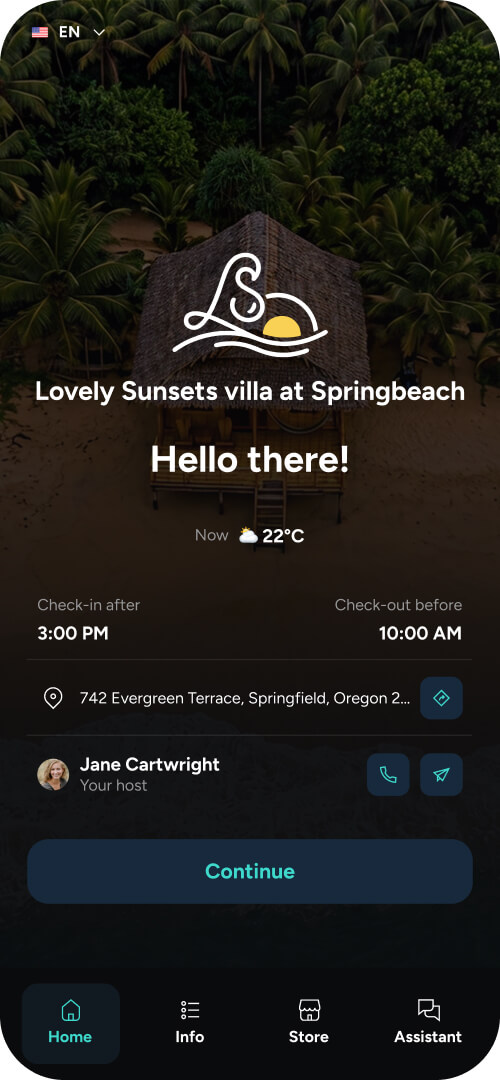
A boutique hotel can turn this into an advantage by presenting its personality, its recommendations, and its practical information through a single, beautifully designed digital guidebook or hotel compendium the guest keeps on their phone throughout the stay. It carries the property's character in its design, answers the practical questions before they are asked, and offers genuinely local recommendations that a chain's generic concierge desk cannot match.
Done well, this becomes part of the boutique proposition itself. An in-guidebook chatbot answers guest questions instantly and around the clock, delivering the responsive, attentive service that defines a boutique stay without stretching a small team.
The guide can surface the property's own experiences and upsells in a way that feels like curation rather than selling. And because it is digital, it can express the hotel's individual character far more richly than any printed material.
For operators thinking about how to build this kind of experience deliberately, the hotelier's playbook is a useful starting point, and Touch Stay's guidebooks for boutique hotels are built specifically for properties competing on exactly this ground.
The strategic point is this. A boutique hotel wins by being everything a chain cannot be, and the guest experience is where that difference is felt most directly. Investing in a personal, characterful, genuinely helpful experience is not a nicety for an independent operator. It is the whole competitive strategy, expressed in the one arena where a small property can decisively out-host a giant.
Frequently asked questions
Hotels are commonly classified along three axes: by size and structure (chain, independent, boutique, aparthotel, motel), by service level (budget, midscale, full-service, luxury), and by purpose and guest (business, resort, airport, bed and breakfast, extended-stay). Most properties can be described by their position on all three at once.
A boutique hotel is a small, independent, design-led property defined by individual character and personalized service. Typically ranging from a handful to around a hundred rooms, boutique hotels reject the standardization of large chains in favor of a distinctive aesthetic, a strong sense of place, and attentive, individualized hospitality.
A chain hotel competes on scale, consistency, and the reassurance of a known brand, offering a predictable experience across many locations. A boutique hotel competes on character, individuality, and personal service, offering a distinctive, locally rooted experience that a standardized chain cannot replicate. The two serve different guest priorities: predictability versus distinctiveness.
There is no strict rule, but most boutique hotels have somewhere between a handful and around a hundred rooms. The small scale is central to the concept, since it enables the personal service and individual character that define the category and distinguish boutique properties from larger hotels.
Not by matching the chains on scale, but by delivering what scale cannot: distinctiveness, personal service, local authenticity, and a memorable guest experience. The guest experience in particular, including how personally and seamlessly a property delivers information and hospitality, is the arena where a small independent can decisively outperform a large chain.
Touch Stay




Be the first to know!
Join our newsletter for early access to:
- ✅ Free guides
- ✅ Pro tips & tricks
- ✅ Time saving tutorials
- ✅ Latest blog posts
- ✅ Checklists & templates
Thanks for subscribing! You're on the list.