

Summarize in
A generic "Welcome to our hotel, we hope you enjoy your stay" email gets deleted before the guest reaches the lobby. The welcome that actually works is the one a guest saves to their phone and opens again on day two when they need the WiFi password or the pool hours.
This guide shows you how to write a hotel welcome message guests keep, with templates for both the short message and the longer welcome letter, and the practical detail that makes the difference between a note that gets read once and a note that earns its place on a guest's home screen.
In this article, we'll cover:
- Why the hotel welcome matters more than it looks
- What guests actually want from a welcome
- The anatomy of a welcome message guests keep
- Hotel welcome message templates
- Hotel welcome letter templates
- Why paper welcomes get thrown away
- How to make your welcome saveable
- Frequently asked questions
Why the hotel welcome matters more than it looks
A welcome message does more emotional work than its length suggests. It is the moment a guest decides whether they are somewhere that has thought about them or somewhere that is processing them. A warm, specific, useful welcome signals care before the guest has even unpacked. A cold or absent one leaves them to figure the property out alone, which is precisely when small frustrations start to accumulate.
There is a practical dimension too. Every question your welcome answers up front is a question that never reaches your front desk. Across a dataset of 37,359 real guest questions asked inside digital guidebooks, the most-asked topics were overwhelmingly practical: WiFi, check-in and check-out logistics, directions, and parking. A welcome that folds those answers in from the start quietly removes a large share of the queries a front desk fields every day, and it does so while making the guest feel looked after rather than left to fend for themselves.
The welcome, in other words, is not decoration. It is the first and cheapest piece of guest service you offer, and it pays back in both satisfaction and saved staff time.
What guests actually want from a welcome
It is tempting to fill a welcome with flourish: the history of the building, the philosophy of the brand, a paragraph of effusive hospitality language. Guests appreciate warmth, but what they need is information, and the data on guest preferences is unambiguous on this point.
When 1,204 travelers were surveyed about what they most want from their host, the top answers were practical and specific: check-in instructions, WiFi and property details, and clear expectations for the stay. Local recommendations mattered too, but they ranked below the logistics that let a guest actually settle in. Guests are not asking for luxury language. They are asking for the basics, delivered with care.
Just as important is where guests want that information. The same research found that 86% of guests want to receive information on their phone. Printed welcome materials, by contrast, were named by only a tiny fraction. This is the single most important design fact for a modern hotel welcome: it needs to live somewhere the guest can pull up on the device that is already in their hand, at the moment they need it, not on a card that stays behind in the room.
A welcome that combines genuine warmth with the practical answers guests are looking for, delivered to their phone, is a welcome that gets kept.
The anatomy of a welcome message guests keep
A welcome guests save has a recognizable structure. It opens with warmth, delivers the essential logistics, points to where the rest of the information lives, and closes with a human touch. Each element does a specific job.
A warm, personal opening. Use the guest's name if you can, and reference the specific property rather than a generic "our hotel." The difference between "Welcome" and "Welcome to The Harbour Rooms, Priya" is the difference between a form letter and a note written to a person.
The essential logistics, up front. WiFi network and password, check-out time, breakfast hours, and how to reach the front desk. These are the details guests ask about most, so leading with them signals that you already know what they will need.
A clear pointer to everything else. You cannot fit the full house manual into a welcome message, and you should not try. Instead, point to one place where the guest can find the pool hours, the spa menu, the local recommendations, and the parking instructions. A single link to a mobile guide keeps the welcome short while making everything else one tap away.
A human close. A line that sounds like a person wrote it. An offer of help, a local tip you personally love, a genuine "we're glad you're here." This is what turns a functional message into one a guest feels warmly about.
Keep the whole thing scannable. Short paragraphs, a little breathing room, the key details easy to spot at a glance. A guest reading on a phone in a lobby will skim before they read, so make the important parts findable in a two-second scan.
Hotel welcome message templates
A welcome message is the short form, sent by text, email, or shown at check-in. Here are three you can adapt.
The warm and practical standard:
Welcome to [Hotel Name], [Guest Name]. We're so glad you're here. Your room is [number] on the [floor]. WiFi is "[network]", password "[password]". Check-out is [time], and breakfast runs [hours] in [location]. Everything else you might need, from pool hours to our favorite local spots, is in your guide here: [link]. Anything at all, we're on [number] or just reply to this message. Enjoy your stay.
The boutique and personal:
Hi [Guest Name], welcome to [Hotel Name]. We've put you in [room], one of our favorites for the [view/feature]. WiFi: "[network]" / "[password]". We serve breakfast [hours] and check-out is [time]. Your full guide, with our neighborhood recommendations, is here: [link]. If you want a dinner reservation or a tip on the area, just ask, we love helping. Settle in and enjoy.
The pre-arrival message:
[Guest Name], we're looking forward to welcoming you to [Hotel Name] tomorrow. Check-in is from [time]. When you arrive, [parking/entrance instruction]. We've put everything you'll need for your stay, including WiFi, check-out, and local tips, in one place here: [link], so you can save it to your phone before you travel. Safe journey, see you soon.
That last template does something the others do not: it reaches the guest before arrival, when they are still planning, which is exactly when they are most likely to save the link.
Hotel welcome letter templates
A hotel welcome letter is the longer form, traditionally left in the room, and increasingly delivered digitally. It has room for more warmth and more detail. Here is a template you can adapt.
Dear [Guest Name],
Welcome to [Hotel Name]. On behalf of the whole team, we're delighted to have you with us, and we want your stay to be as easy and enjoyable as possible.
A few essentials to get you settled. Your WiFi network is "[network]" with the password "[password]". Breakfast is served [hours] in [location]. Check-out is [time], and if you'd like a later check-out, just ask and we'll do our best. The front desk is reachable any time on [number] or by dialing [extension] from your room.
There's plenty more to enjoy during your stay, from [amenity] to [amenity], along with our team's personal recommendations for the neighborhood. Rather than print it all here, we've gathered everything in one guide you can open on your phone and keep for your whole stay: [link].
If there's anything we can do to make your time with us better, please don't hesitate to ask. We're genuinely happy you chose us.
Warm regards, [Name], [Title] [Hotel Name]
The structure holds whether the letter is printed or digital: warmth, the essentials, a pointer to the full guide, and a sincere close. The one change worth making is delivery, which is the subject of the next two sections.
Why paper welcomes get thrown away
A beautifully printed welcome card is a genuine gesture, but as a piece of guest infrastructure it has a fatal flaw: it does not travel with the guest. It sits on the desk in the room. The moment the guest is in the elevator, at the pool, or out exploring the neighborhood, the card and everything on it, including the WiFi password and the front desk number, is no longer with them.
This is why the same questions keep coming back to the front desk even when the answers were printed and placed in the room. The information existed; it just was not where the guest was standing when they needed it. Paper cannot follow the guest, and it cannot be updated. When breakfast hours change or a new local recommendation is worth sharing, every card in every room is instantly out of date.
A printed welcome also cannot be saved. The single most valuable thing a guest can do with your welcome is keep it, so they open it again on day two and day three instead of calling down. Paper makes that impossible. A digital welcome the guest can save to their phone makes it the default.
None of this means a physical touch has no place. A handwritten name on a card, a small welcome gift, a note on the pillow all carry real warmth. The point is that the working information, the part guests need to reference, should live somewhere it can follow them.
How to make your welcome saveable
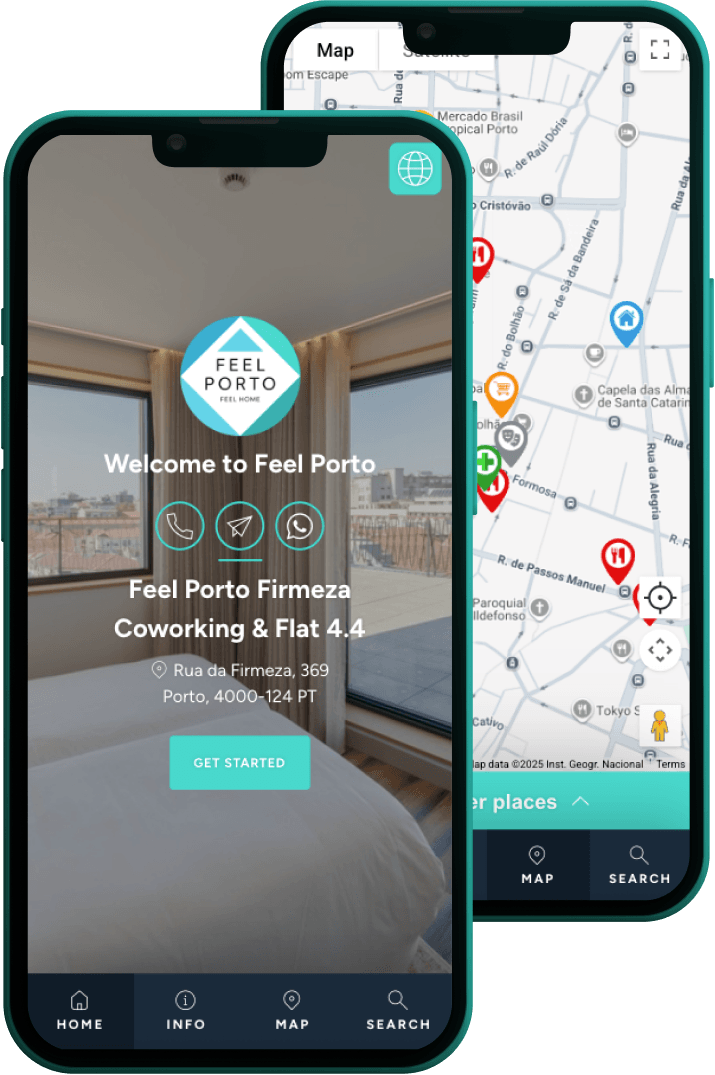
The fix is to deliver the welcome digitally, in a form the guest can open on their phone and return to whenever they need it. In practice, that means a mobile-friendly guide the guest can reach through a single link, sent before or at arrival, with a QR code in the room for anyone who missed it.
This is exactly what a digital guidebook is built to do. The welcome message points to the guide; the guide holds everything else, from WiFi and check-out to the full hotel compendium of amenities, dining, and local recommendations. Because it is a link, the guest can save it to their home screen and open it every day of the stay. Because it is digital, you can update breakfast hours or add a new recommendation once and have it reflected instantly for every guest, with no reprinting.
The saveability compounds. A guide the guest keeps open is a guide that answers the WiFi question, the pool-hours question, and the late-check-out question without a single call to the front desk. It also carries an AI chatbot that answers anything not covered, instantly, day or night, so even the questions you did not anticipate get handled without waking a staff member.
For hotels thinking more broadly about the guest experience, our hotelier's playbook goes deeper on turning moments like the welcome into lasting impressions.
The welcome message stays short and warm. The guide does the heavy lifting. And because the guide lives on the guest's phone, the whole thing follows them from the lobby to the last morning of their stay, which is the entire point of a welcome that works.
Frequently asked questions
A hotel welcome message should include a warm, personal greeting, the essential logistics guests ask about most (WiFi network and password, check-out time, breakfast hours, and how to reach the front desk), a link to where the rest of the information lives, and a sincere closing line. Keep it short and scannable, since guests skim before they read.
A hotel welcome message is the short form, sent by text or email or shown at check-in, focused on essentials and warmth. A hotel welcome letter is the longer form, traditionally left in the room, with more room for detail and personality. Both should point the guest to one place where the full information lives, ideally a guide they can save to their phone.
Deliver it digitally, lead with the practical details guests need most, and point to a mobile-friendly guide the guest can save to their phone. Guests keep a welcome when it is genuinely useful and lives on the device already in their hand. A printed card cannot be saved or updated, which is why it gets set down and forgotten.
Both have a role, but the working information should be digital. A printed card carries warmth but stays in the room and cannot follow the guest or be updated. A digital welcome the guest can save to their phone travels with them, answers questions throughout the stay, and can be updated instantly for every guest at once.
Guests ask the front desk the same practical questions repeatedly, led by WiFi, check-out, and directions. A welcome that answers these up front, and links to a guide that answers everything else, removes a large share of those calls. The information has to be somewhere the guest can reference on their phone, not on a card left behind in the room.
Touch Stay
Be the first to know!
Join our newsletter for early access to:
- ✅ Free guides
- ✅ Pro tips & tricks
- ✅ Time saving tutorials
- ✅ Latest blog posts
- ✅ Checklists & templates