

Summarize in
Booking.com, which belongs to Booking Holdings, booked 1.2 billion room nights in 2025. Meanwhile, Expedia, part of belongs to Expedia Group, which also owns Hotels.com and Vrbo, reportedly booked 415.4 million room nights in the same year.
So which of these two travel industry behemoths should you use?
Here's the short answer:
- Booking.com is usually the better pick for international trips, flexible cancellation and a huge choice of homes and apartments.
- Expedia is usually the better pick for package trips (flight plus hotel) and for travelers in North America who already earn One Key rewards.
Below, we compare both for guests and for hosts, including the changes that landed in 2026.
In this article
- Booking.com vs Expedia at a glance
- Booking.com vs Expedia for guests
- Booking.com vs Expedia for hosts
- So, Booking.com or Expedia?
- Direct bookings: keep more of every stay
- Booking.com vs Expedia FAQ
Booking.com vs Expedia at a glance
|
Booking.com |
Expedia |
|
|
Owned by |
Booking Holdings (also Priceline, Agoda, Kayak) |
Expedia Group (also Hotels.com, Vrbo, Orbitz, Travelocity) |
|
Room nights booked in 2025 |
1.2 billion (Booking Holdings) |
415.4 million (Expedia Group) |
|
Inventory |
33M+ reported listings, from hotels to homes |
Hotels worldwide, plus vacation rentals from Vrbo |
|
Loyalty program |
Genius: free, 10% to 20% off at participating stays |
One Key: 1% to 3% back in OneKeyCash on hotels, depending on tier |
|
Price promise |
Price match until 24 hours before arrival |
Price Guarantee removed in July 2026 |
|
Strongest for |
International trips, apartments and homes, flexible bookings |
Flight-plus-hotel packages, North American travelers |
|
Typical host commission |
About 15% in the US (10% to 25% worldwide) |
About 15% to 30% for hotels; 12% to 15% for Vrbo rentals |
|
How hosts get paid |
Payments by Booking.com, or the property charges the guest |
Expedia Collect, or the property charges the guest (Hotel Collect) |
Booking.com vs Expedia for guests
Prices
For the same room on the same dates, the price is often identical or very close between the two platforms. Where you'll see a difference is in what's bundled in. Expedia's flight-plus-hotel packages can come in cheaper than booking each part on its own, because hotels can offer lower rates when the room is sold inside a package. Booking.com sells flights and rental cars too, but packages aren't its focus.
Booking.com also offers a price match, meaning if you find the same stay cheaper elsewhere, with the same cancellation policy and dates, you can claim the difference until 24 hours before arrival. Meanwhile, Expedia removed its Price Guarantee on July 28, 2026.
Loyalty programs
This is where the two differ most.
- Booking.com Genius gives you 10% off participating stays as soon as you sign in. After 5 bookings in two years you reach Level 2 (10% to 15% off, plus free breakfasts and upgrades at some stays). After 15 bookings you reach Level 3 (up to 20% off and priority support). The discount comes off the price straight away.
- Expedia One Key gives you OneKeyCash to spend on future trips across Expedia, Hotels.com and Vrbo. Since July 28, 2026, entry-level Blue members earn 1% on hotels (down from 2%), Silver and Gold earn 2% and Platinum earns 3%. Flights no longer earn OneKeyCash.
If you travel a few times a year, Genius usually saves you more because the discount is instant. If you book a lot through Expedia's brands, and especially if you reach Gold or Platinum, One Key's rewards and perks can add up.
Cancellations and flexibility
Both platforms let you filter for free cancellation, and both show the policy before you pay. Booking.com has a lot of "book now, pay later" and free-cancellation rates, which is a big part of its appeal. On either site, always check whether a rate is non-refundable before you book, because the cheapest price often is.
Choice of places to stay
Booking.com reports more than 33 million listings, and alternative accommodations like apartments, homes and B&Bs now make up about 37% of its room nights. Expedia's strength is hotels, with vacation homes coming from its sister brand, Vrbo.
Trust and support
Both are large, established companies, and both have plenty of happy and unhappy customers online. Most complaints on either site come down to the same things: a property that doesn't match its listing, or a change that's hard to sort out through a middleman. Booking.com's Genius Level 3 adds priority support on all stays.
The verdict for guests: Choose Booking.com for international trips, homes and apartments, and instant loyalty discounts. Choose Expedia for packages, and if you're already building up One Key status.
Booking.com vs Expedia for hosts
If you run a vacation rental, B&B or small hotel, the question isn't which site is better. It's which one brings you the right guests at a cost that still leaves you a profit.
Fees and commission
- Booking.com charges a commission on each stay, around 15% in the US, with a typical range of 10% to 25% depending on country and property type. If you use Payments by Booking.com, processing adds 1.1% to 3.1%. Joining Genius means funding a 10% to 20% discount for members, and commission is charged on the discounted price.
- Expedia commissions for hotels typically run 15% to 30%, depending on market and property type, and you can pay more for better placement. Most vacation rentals reach Expedia through Vrbo, which moved hosts to a 12% to 15% commission on bookings made from October 29, 2026, replacing the old 5% plus 3% processing model.
Whichever you choose, work your commission into your nightly rate, and check the numbers again when a platform changes its terms.
How you get paid
Booking.com lets you charge guests yourself or let Booking.com collect payment for you. Expedia offers a similar choice: with Expedia Collect, Expedia charges the guest and pays you by virtual card or bank transfer, minus commission. With Hotel Collect, you charge the guest directly and Expedia invoices you for commission later.
The guests each platform brings
Booking.com skews international and urban, with a lot of short stays booked by destination and date. Expedia's demand is strongest in North America and often comes from travelers building a package, who may add a stay partway through a trip. For whole-home leisure stays, Vrbo's family travelers are often the better fit.
Listing a vacation rental
You can list a home or apartment directly on Booking.com, and alternative accommodation listings there grew 9% year over year in the third quarter of 2026. On the Expedia side, homes are usually listed through Vrbo and can then appear on Expedia too. Expedia Group is also rolling out Vrbo listings to its network of travel businesses and agents.
Control over your prices
In the European Economic Area, the EU's Digital Markets Act bans Booking.com from using parity clauses. That means you're free to offer a different price or better terms on your own website. Since September 2026, prices you set elsewhere also no longer affect your eligibility for Booking.com's sponsored benefits. If you host in Europe, that's a real opening for direct bookings.
The verdict for hosts: If your guests are international or city-based, start with Booking.com. If you rent a whole home to domestic leisure travelers in North America, start with Vrbo and let Expedia's network do the rest. Many hosts use both, with a channel manager keeping calendars in sync so nothing gets double-booked. Our guide to the best short-term rental platforms compares more options.
So, Booking.com or Expedia?
Choose Booking.com if you:
- Travel internationally, especially in Europe and Asia
- Want instant discounts without having to build up status
- Like flexible, pay-later bookings
- Are a host with city, international or short-stay guests
Choose Expedia if you:
- Book flights and hotels together
- Already have One Key status, or book often across Expedia, Hotels.com and Vrbo
- Are a host whose guests are mostly North American leisure travelers (usually via Vrbo)
For most hosts, the real answer is both, plus a growing share of direct bookings. OTAs are great at finding you new guests, but every booking comes with a commission. Our guide to OTAs: friends or foes? digs into that trade-off, and here's how to build more independence from them.
Direct bookings: keep more of every stay
While both Booking.com and Expedia are great for finding new guests, it's important to any short term rental business to consider commission free direct bookings.
For instance, on a $1,000 stay, a 15% commission is $150. Book that same guest directly next time and the $150 stays with you, along with the relationship.
Direct bookings also mean:
- Your rules and your prices. You set the cancellation policy, the deposit and the rate. In Europe, the Digital Markets Act means Booking.com can't stop you from offering a better price on your own website.
- Your guest data. You know who's staying and can keep in touch with guests who say yes to hearing from you.
- Less risk. If a platform changes its fees or its search rankings, your business doesn't depend on it.
Most hosts won't switch off OTAs, and they don't need to. The goal is a healthy mix: OTAs for discovery, and direct bookings from repeat guests, referrals and your own website. Here are the benefits of direct bookings in more detail.
How Touch Stay helps you grow direct bookings
Your guidebook is the one thing every guest opens during their stay, so it's a natural place to turn a great stay into the next booking. For guests who book directly with you, Touch Stay lets you switch on:
- Email Capture and the Contact Collection pop-up, with marketing consent, so you can stay in touch with guests who opt in.
- Return-stay offers, like a discount code for their next booking on your website.
- Ratings and Google review invitations, so happy guests help new ones find you.
- The Store, for extras like early check-in, late checkout or a welcome basket, with no OTA commission on top.
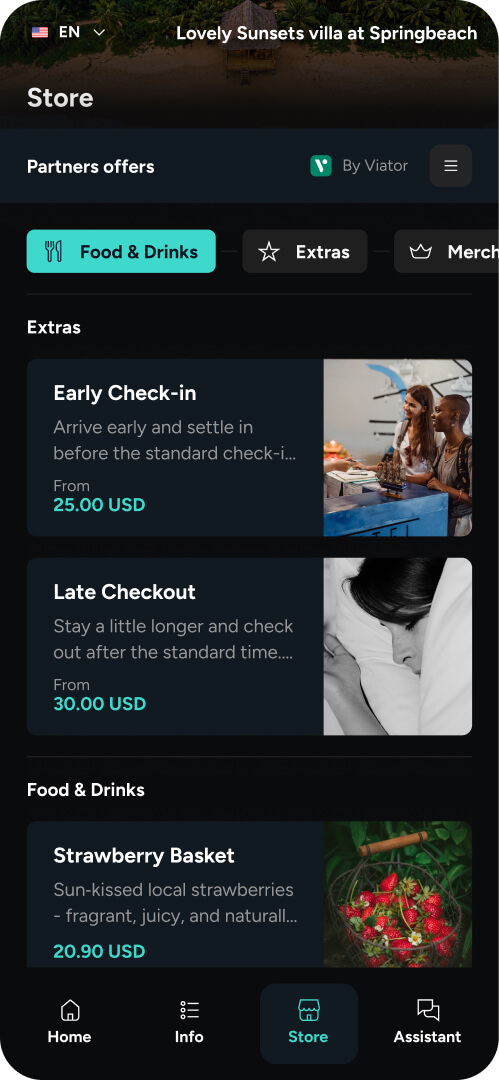
The Store lets guests add extras like late checkout or a bottle of local wine to their stay.
One thing to keep in mind: Booking.com and Expedia, like Airbnb, have rules about promoting your own website to guests who booked through them. Keep "book direct" offers for the guests who already book with you, and grow your direct business through your website, your past guests and word of mouth. Touch Stay's OTA Compliance Centre helps by hiding marketing prompts and the topics you choose, depending on where a guest booked.
Give every guest the same great stay, wherever they booked
Guests who book through Booking.com, Expedia or your own website all have the same questions once they arrive: how do I get in, what's the Wi-Fi, where do I park? A Touch Stay digital guidebook answers all of them in one link, with no app to download.
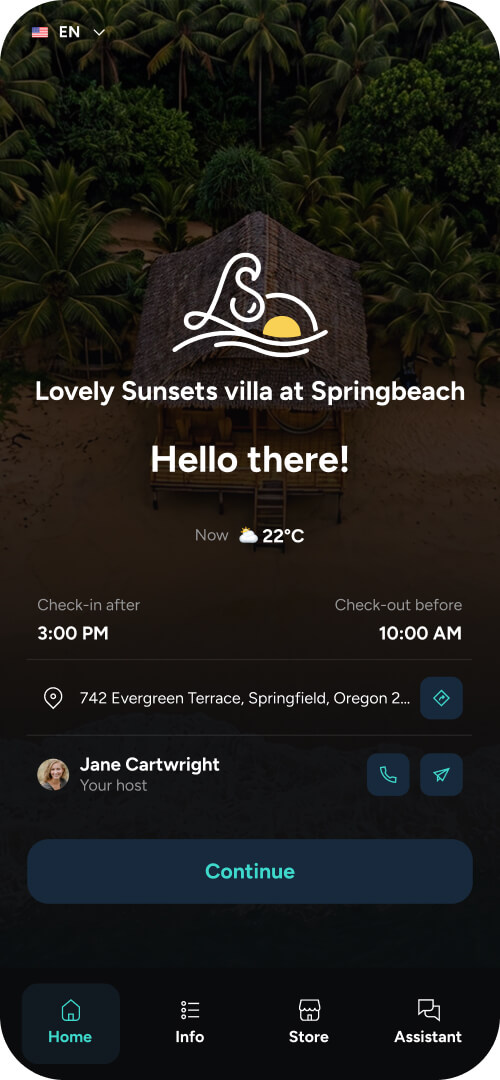
A Touch Stay guidebook: extras in the Store, arrival details on the home screen, and an AI assistant for guest questions.
- Clear arrival details, so check-in goes smoothly no matter which platform the booking came from. Here's what to include in your check-in instructions.
- A 24/7 AI assistant that answers guest questions from your guidebook content.
- A Store for extras like early check-in, late checkout or a welcome basket, so you can earn more from every stay.
- A free plan to get started, with one guidebook you can share with every guest.
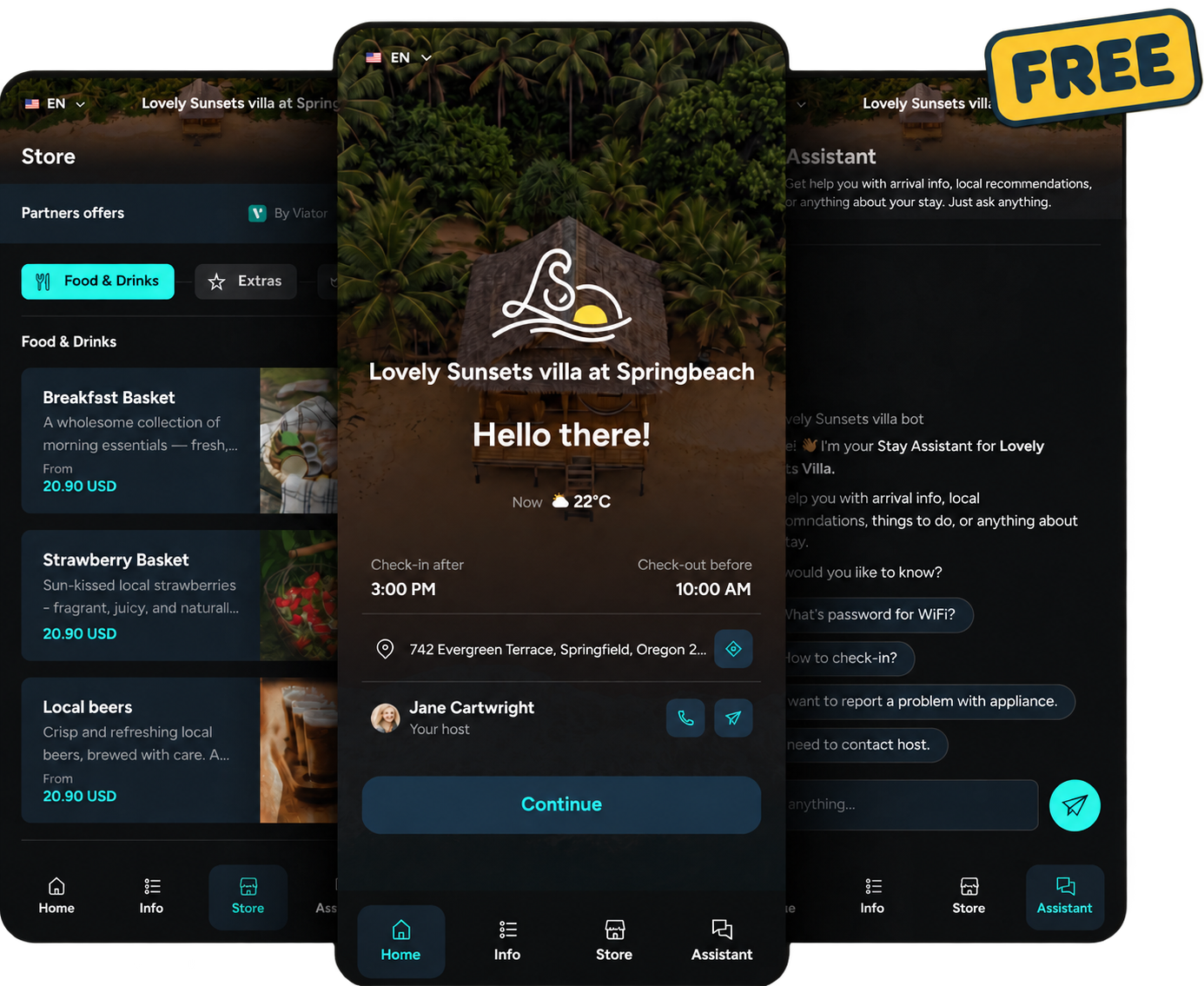
Check-in and checkout times, directions and a one-tap way to reach the host, the same for every guest whichever site they booked on.
Using Vrbo to reach Expedia travelers? Here's how to create a Vrbo welcome guide with Touch Stay.
A great stay leads to better reviews, and better reviews help you rank on every platform. Over time, it also gives guests a reason to come back and book with you directly.
Booking.com vs Expedia FAQ