

Summarize in
Hotel guests expect quick answers, easy check-ins, and helpful information throughout their stay. But for hotel teams, answering the same questions day after day can take up valuable time.
That's where a hotel chatbot can help.
A hotel chatbot uses automation or AI to answer guest questions, share information, and support tasks like booking inquiries. The right solution can reduce repetitive work, improve communication, and help guests enjoy a smoother stay.
Whether you manage an independent hotel, a boutique property, or a larger hospitality business, understanding how hotel chatbots work can help you decide whether they're right for your property.
In this guide, we'll explore the benefits of hotel chatbots, common use cases, and what to look for when choosing a solution.
Here's what we'll cover:
- What is a hotel chatbot?
- Benefits of using a hotel chatbot
- Common hotel chatbot use cases
- Hotel chatbot vs. digital guest guidebook
- How to choose the best hotel chatbot
- Final thoughts
- Frequently asked questions
What is a hotel chatbot?
A hotel chatbot is software that communicates with guests through an automated conversation. It can answer frequently asked questions, provide property information, and help guests complete certain tasks without requiring staff to respond to every message.
There are two main types of hotel chatbots.
Rule-based chatbots follow predefined scripts and decision trees. They're useful for answering predictable questions, such as check-in times, parking information, and breakfast hours.
AI hotel chatbots use artificial intelligence to understand natural language and respond to a wider range of questions. Rather than relying on exact keywords, they can recognize different ways of asking the same thing.
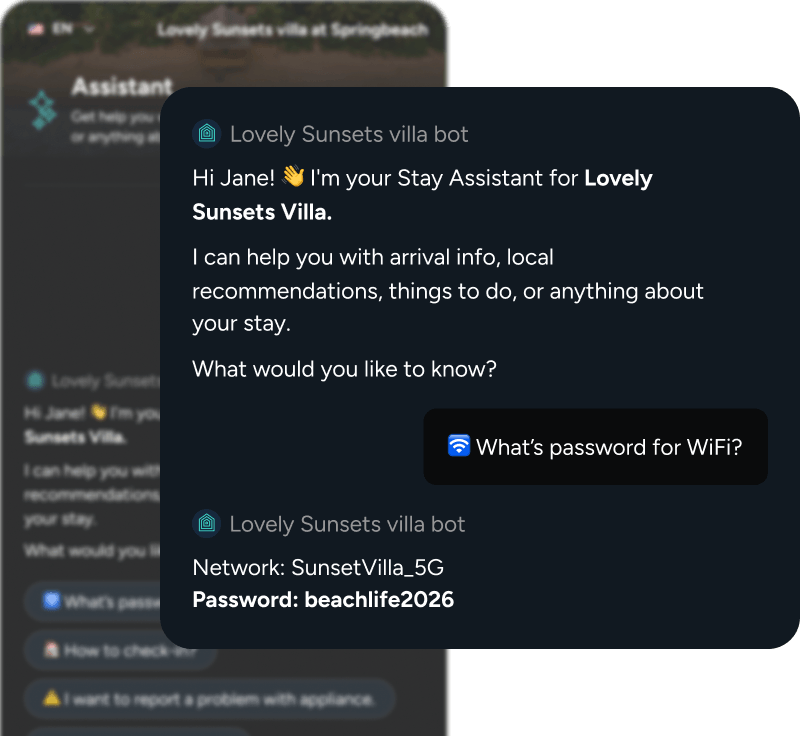
For example, a guest might ask, "When can I check in?" or "Can I get into my room before 3 p.m.?" An AI chatbot may recognize the underlying question and provide an appropriate answer using the information available to it.
Some chatbots also integrate with booking engines and property management systems to support reservations, availability checks, and service requests.
The capabilities vary by provider, so it's important to understand what a chatbot can actually do before investing in one.
Benefits of using a chatbot in the hotel industry
A hospitality chatbot can help your team manage guest communication more efficiently while making it easier for guests to find the information they need.
Here are six key benefits of using a chatbot for your hotel.
1. Reduce repetitive guest questions
How many times has your team answered questions about Wi-Fi, parking, check-in times, or local recommendations in a single week?
A hotel chatbot can automate responses to common questions, reducing the need for staff to repeat the same information throughout the day.
This gives your team more time to focus on welcoming guests and handling requests that need personal attention.
💡 Pro tip: Start by identifying your most frequently asked questions. Our guide to popular guest FAQs for your digital welcome book can help you decide which information to make readily available.
2. Provide faster guest support
Guests don't always have questions during working hours. They might need help late at night or early in the morning, when fewer staff members are available.
A chatbot can provide automated answers around the clock, depending on how it's configured.
For more complex issues, such as maintenance emergencies or billing disputes, guests should still have a clear way to contact a staff member.
3. Improve the guest experience
Guests want to spend less time searching for information and more time enjoying their stay.
A chatbot can make it easier to find answers about hotel facilities, check-in procedures, dining options, and local attractions.
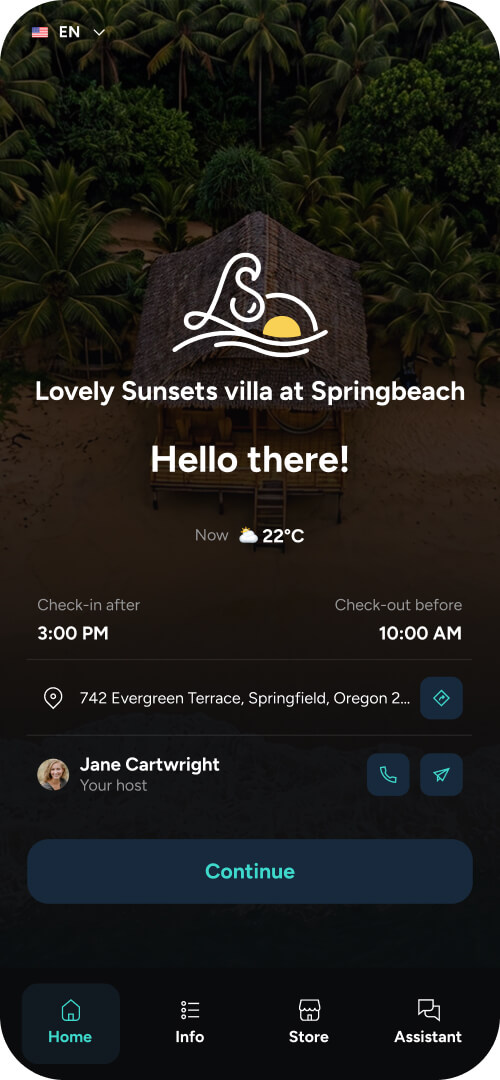
Another option is a digital guest guidebook, which organizes essential property information and recommendations in one accessible place.
Both approaches can improve the guest experience by making information easier to find. The best choice depends on how your guests prefer to access it.
For more ideas, explore our guide to improving the hotel guest experience.
4. Support multilingual communication
Hotels welcome guests from all over the world. AI-powered chatbots can support multiple languages, helping international visitors access information without requiring staff to speak every language themselves.
Before choosing a solution, check its language capabilities and test how accurately it handles property-specific instructions. Incorrect translations can cause confusion, especially around check-in procedures and safety information.
5. Support bookings and upsells
A hotel booking chatbot can answer pre-booking questions about room types, amenities, cancellation policies, and parking.
Some solutions can also check availability or help guests complete reservations through integrations with booking systems.
During a stay, chatbots may promote additional services, such as late checkout, room upgrades, or local experiences.
These features depend on the platform, so check whether they're included before making a decision.
6. Free up staff to focus on hospitality
Automation works best when it supports your team rather than replacing every human interaction.
By handling straightforward questions, a chatbot can give staff more time to resolve problems, provide personalized recommendations, and deliver the kind of service that makes a stay memorable.
The goal isn't to automate everything. It's to make routine communication more manageable while keeping personal support available.
Common hotel chatbot use cases
Hotel chatbots can support different stages of the guest journey, from the first website visit to post-stay communication.
Common use cases include:
- Pre-booking questions: Answer questions about room types, amenities, parking, and cancellation policies.
- Check-in instructions: Share arrival information, directions, and self-check-in procedures.
- During-stay support: Provide information about Wi-Fi, hotel facilities, housekeeping, and local attractions.
- Service requests: Help guests request extra towels, housekeeping, or maintenance, where integrations allow.
- Upselling: Promote relevant extras, such as spa treatments, airport transfers, and late checkout.
- Guest feedback: Collect feedback or direct guests to review platforms after their stay.
The most useful starting point is usually the questions your team receives most often. Automating a handful of common inquiries can be more valuable than introducing a complicated system with features you rarely use.
Hotel chatbot vs. digital guest guidebook
A hotel chatbot and a digital guest guidebook both help guests access information, but they work differently.
A chatbot lets guests ask questions conversationally. A digital guidebook organizes property information into sections guests can browse whenever they need it.
|
Feature |
Hotel chatbot |
Digital guest guidebook |
|---|---|---|
|
Finding information |
Ask questions conversationally |
Browse organized content |
|
Property instructions |
Provides answers based on available information |
Displays detailed instructions and images |
|
Local recommendations |
Suggests options when supported |
Organizes recommendations into categories |
|
Guest communication |
Automates conversations |
Centralizes guest-facing information |
|
AI functionality |
Depends on the platform |
Some guidebooks include an integrated AI chatbot |
The two approaches can also complement each other.
How Touch Stay helps simplify guest communication
Touch Stay combines digital guest guidebooks with an AI chatbot that answers guest questions using information in the guidebook.
Guests can ask about Wi-Fi, check-in instructions, parking, house rules, and local recommendations. The chatbot uses your guidebook content to provide property-specific answers, helping guests find information without messaging your team for every detail.
With Touch Stay, you can also:
- Share arrival instructions before guests check in.
- Explain how to use property features and appliances.
- Organize house rules and practical information.
- Recommend local restaurants, attractions, and experiences.
- Identify gaps in your information by reviewing guest questions.
Learn more about the Touch Stay AI Chatbot and how it works alongside your digital guidebook.
Ready to spend less time answering repetitive questions?
Explore Touch Stay's digital guidebooks and see how organized property information and AI-powered answers can help create a smoother guest experience.
How to choose the best hotel chatbot
If you're comparing hotel chatbot solutions, look beyond the sales pitch. The best option depends on your property's needs, budget, and existing systems.
Consider these five factors.
1. Identify your main goals
Are you trying to reduce front desk inquiries, answer website questions, increase direct bookings, or improve communication during a stay?
Define your priorities before comparing providers. This will help you focus on features that solve real problems rather than paying for functionality you don't need.
2. Check accuracy and AI capabilities
Find out what information the chatbot uses to generate responses and how it handles questions it can't answer.
Look for reliable answers, straightforward content updates, and clear safeguards against inaccurate information. Test it with real guest questions before rolling it out.
3. Review integrations
Depending on your needs, you might want a chatbot that connects with your property management system, booking engine, or guest messaging software.
Check which integrations are available, whether additional fees apply, and how much work is required to get everything running.
4. Compare pricing and support
Pricing varies by provider, property size, features, and usage. Consider setup fees, subscriptions, training, and ongoing maintenance.
You should also check whether the platform offers human handover for complicated requests and what support is available if something goes wrong.
5. Test the guest experience
Try common scenarios involving check-in, parking, breakfast, Wi-Fi, and booking policies.
Ask the same question in different ways and see how the chatbot responds when it doesn't understand. Responses should be accurate, easy to follow, and helpful.
A chatbot should make communication simpler, not create another obstacle for guests.
Final thoughts on hotel chatbots
Hotel chatbots can help hospitality teams answer common questions, provide faster responses, and reduce repetitive work. They're particularly useful for properties that receive a high volume of similar inquiries or need to provide information outside regular working hours.
However, a standalone chatbot isn't the only solution. If your main challenge is making property information easier to access, a digital guest guidebook may be a simpler starting point. A guidebook with an integrated AI chatbot can combine organized information with conversational support.
Whatever you choose, start with your guests' needs, keep your information accurate, and make sure human assistance remains available when it's needed.
Want to make guest communication easier?
Touch Stay combines digital guest guidebooks with an AI chatbot to help guests find answers while reducing repetitive questions for your team.
Frequently asked questions about hotel chatbots